segunda-feira, 6 de maio de 2019

For two weeks after Jenny Odell’s new book How To Do Nothing arrived in the mail, I was too busy to pick it up.
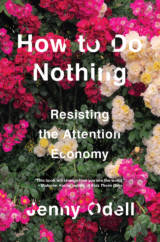
Jenny Odell's 'How to Do Nothing: Resisting the Attention Economy.'Jenny Odell's 'How to Do Nothing: Resisting the Attention Economy.' (Courtesy of Melville House)

That feels ridiculous to write, since I’d been looking forward to reading it since well before publication. As the artist behind projects like the ‘Bureau of Suspended Objects’ at the San Francisco dump and the mind-expanding essay There's No Such Thing As a Free Watch, Odell has long been one of those people whose grocery lists, even, I feel certain I would find scintillati ng.

But I was slammed: I had deadlines to meet, emails to send, and social obligations and/or networking events that all had a way of bleeding over into my downtime. As a full-time freelance writer, I always know exactly what’s in my checking account. And even on the best days, this knowledge forms a sort of cloud overhead, casting a guilty shadow of understanding that, at any given time, I really should be working.

I also have to keep up on the news, be on Twitter, promote my own work if I want anyone to see it. I’ve grown accustomed to the fact that a good deal of my work is simply selling myselfâ€"sorry, “branding”â€"and also to the nonexistent line between my professional and personal lives. It all adds up to a sense of always being busy. Also, the new season of Queer Eye had just arrived on Netflix.

Near the end of the second week of Odell’s book sitting on my shelf unopened, after a particularly unproductive dayâ€"the kind where the guilt over how little you’ve accomplished becomes an activity in and of itselfâ€"I went to a Mission District bar to see a friend’s band play. A typical Thursday night for me, except that I was 26 weeks pregnant, and looked it, and it turned out this show meant seeing a handful of people I hadn’t seen in a while, people who were not expecting to find me in such a state.

It was a great show, and I stayed until the last band had played the last note, generally behaving the way I always do at shows (minus a beer or two). At some point before I split for home, a musician friend who’d just been on stage gave me a hug and, eyeing my belly, said with innocent admiration that it was great to see me “out.” He seemed amused that I had even danced a little.

He meant nothing by it, yet the defensiveness that rose up in my throat was immediate. I was still me. Why wouldn’t I be out?

But the next day, as I bristled at his implicationâ€"I’m pregnant, I don’t have polio, I said to a friend over brunchâ€"I also couldn’t ignore the hatch door of possibility that had just swung open before me. People’s expectations for me had changed shape overnight.

I was pregnant, and with this fact came coded privileges. I had an excuse to go home early. I had an excuse to stay home in the first place. Because I was visibly “working” to create a human being, and doing it around the clock, I realized I had a limited-time-only passâ€"for a strange, temporal periodâ€"to do nothing else at all.

“At some point, I began to think of this as an activist book disguised as a self-help book,” writes Odell in How To Do Nothing’s introduction, a disclaimer that becomes unnecessary midway through the first chapter. Despite the book's title, anyone hoping for Wikihow-style bullet points about how to achieve enlightenment via inaction should look elsewhere. (Perhaps to Wikihow. Those illustrations!).

What Odell delivers instead, over the course of six chapter-length essays, is a labyrinth of questions about the usefulness of a life focused on "usefulness"â€"and what gets overlooked in a culture obsessed with productivity.

There's a reason, Odell suggests, that so many of us increasingly spend our days feeling like our brains are occupied by tiny wind-up monkeys playing cymbalsâ€"overstimulated but unfocused, lonely while supposedly more connected than ever. How To Do Nothing is a call to arms about the fractured state of human attention (a commodity Odell paints as our most precious resource), and what’s at stake for society when we allow it to be bought and sold by companies whose profits depend on our willingness to stay addicted.

To do this, Odell finds inspiration in the bioregionalism movement; touches on organized labor and the political potential of work stoppage; traces the history of communes and other forms of physical escape from the rat race and their through-line to modern “digital detox programs,” noting the pitfalls of each; looks to trees as role models for passive resistance; and outlines the bubble effect of online communities like Nextdoor (in contrast with, literally, having dinner with one’s neighbor next door).

Odell has a historian’s obsessiveness for the provenance of her ideas, and she pulls from a broad swath of teachers, including Plato, Audre Lorde, the third-century hermit St. Anthony, the fourth-century philosopher Epicurus, the technology ethicist James Williams, Herman Melville’s Bartleby the Scrivener, a slew of 20th and 21st century performance artists, Rebecca Solnit, and Tom Green (who, it turns out, invented planking back in 1994).

A hundred different trend stories can tell you too much screentime is bad for your brain. Intellectually rigorous and quietly radical, Odell’s book extrapolates those studies outward to argue that what's detrimental for one's personal health is, potentially, fatal for one's community. When we forfeit our ability to interact meaningfully with our environment and with other human beings, she argues, we lose the very fabric of society: the means to truly connect and support one another, to organize, to make meaningful social and political change.

The antidote she suggests is both simple and challenging: a reclaiming and redirecting of attention to our literal surroundings. The book forces some practice on this; at times, the reader is made to slow down to the pace and character of a physical space, and the reading itself becomes a trust fall of observation. We have to believe that the description of a dam or a type of bird will not only “pay off” in terms of a larger point. It is, in fact, the larger pointâ€"to notice how the world opens up when you step back from the “financially incentivized proliferation of chatter” that makes up the digital age, and simply see what’s around you as worthy of attention.

To that end, we go birdwatching in the Oakland hills, sit in the Morcom Rose Garden, and explore the topography of Odell’s native Cupertino via its creeks and office parks. In one example of an attention “exercise,” Odell recalls going to see the San Francisco Symphony perform John Cage’s Song Books, an experimental piece made up of ambient sound, in which the musicians dress in plain clothes and futz around with everyday, noise-making props like a typewriter, a set of cards, and a blender.

In the absence of music, the audience’s uncomfortable throat-clearing and chair sounds all build tension, becoming part of the score, until conductor Michael Tilson Thomas uses the blender to make a smoothieâ€"then takes a sip and makes a satisfied face. “After that, all bets were off, with laughter tumbling down from the seats toward the stage and integrating itself into the piece,” writes Odell. Then:

More than just the conventions of the symphony hall were broken open that night. I walked out of the symphony hall down Grove Street to catch the MUNI, and heard every sound with a new clarityâ€"the cars, the footsteps, the wind, the electric buses. Actually, it wasn’t so much that I heard these clearly as that I heard them at all. How was it, I wondered that I could have lived in a city for four years already… and never have actually heard anything? For months after this, I was a different person. At times, it was enough to make me laugh out loud.

The type of heightened awareness she’s describingâ€"not just of her surroundings but of her own everyday reality as a construction, something malleableâ€"is a state I mostly hear people talk about as the result of either psychedelics or a disciplined meditation practice, or both. The suggestion that each of us already has what we need for this in our brainsâ€"that such a shift in perception might be possible through simply, consciously taking back our attention from the corporate forces working to drain itâ€"is nothing short of exhilarating.

I mean: You’re telling me that if I retrain myself not to look at Twitter 32 times a day, I might be able to go on a walk and look at trees and hear birds and notice the hum of the ecosystem and tap into the fact that everything in the world has a secret life and pulse that’s always there and that everything’s connected and technically I’m part of it? And that it’s simply up to me to remember and keep that front and center (instead of thinking about who shared my latest story on Facebook or what Ariana Grande said about Jim Carrey or whether or not I should cancel my ClassPass membership) and that in so doing I would actually be fighting back against the creep of technofascism and resisting capitalism’s hold on the most vital and wild aspects of humanityâ€"and that all of that is possible without drugs?

It’s hard to put into a hashtag. But it sure beats anything I ever learned from D.A.R.E.
As I write this, I’m well into my third trimester, and I’m just getting used to the ways it’s changed how I move through the world: walking down 16th street, I’m met with a warm, protective nod from the older man smoking outside a bar at 1pm on a Tuesday, as opposed to a lecherous comment. Women with babies offer me conspiratorial smiles. In the past 48 hours I’ve had two different groups of people make a fuss about insisting I sit down on the bus. (I’ve chosen to take this as reassurance that chivalry is alive and well, and not as “You look like you might go into labor any minute and I’d prefer you not be standing next to me when you do.”)

Still, more surprising (to me) are the changes in how I treat myself: basic tenets of “self-care” that have always eluded me became unavoidable overnight. My needs and responses to them have become animal-like, elemental: when I’m tired, I sleep. When I’m hungry, I eat. I have to work, so I work, and I love my friends and family, so I see my friends and family. I show up for my community when I want or need to. But there’s very little striving. I want to say I don't feel tethered to notifications the way I'm used to. When I don’t want to do anything, I really don’t do anything. And I don’t feel guilty about it. It’s very new and it's very, very weird.

It’s surely no coincidence that this newfound ability to “listen to my body,” to use more terminology that grosses me out, arrived at the same time I stopped being able to bulldoze over physiological instincts with quick fixes: tired=more caffeine, stressed out at the end of the day=have some whiskey, and so on.

But it also occurs to me that I’ve truly never felt allowed to indulge in the possibility of non-productivity before. It definitely occurs to me that I only feel this way because it’s temporary.
The thing about refusal to participate as a method of resistance, of courseâ€"whether mentally, from the news cycle, via quitting social media, or physically, from urban society, by splitting for a cabin in the woodsâ€"is that it necessitates a certain level of privilege. (Thoreau only spent one night in jail, after all, because some rich aunt paid his back taxes.)

Once you start seeing rest as a luxury good, it’s everywhere; most recently, I loved this piece on shade in Los Angeles as an index of inequality. And when it comes to mental rest, we all reflexively know the prerequisites: in the first months of the Trump administration, when people mentioned in an offhand way that they just “couldn’t read the news anymore,” those people were generally not undocumented immigrants or Muslims or trans womenâ€"members of groups for whom the stakes of inattention are life and death.

Odell knows this, too, and she owns, among others, the privileges that made it possible for her to even write this book. Yet in so doing, she winds up back at the labor movementâ€"perhaps the last tangible win for the working class in Americaâ€"and reminds us that the “eight hours of work, eight hours for rest, eight hours for what we will” was a campaign “about a demarcation of time”:

The removal of economic security for working people dissolves those boundaries... so that we are left with twenty-four potentially monetizable hours that are sometimes not even restricted to our time zones or our sleep cycles.

In a situation where every waking moment has become the time in which we make our living, and when we submit even our leisure for numerical evaluation via likes on Facebook and Instagram, constantly checking on its performance like one checks a stock, monitoring the ongoing development of our personal brand, time becomes an economic resource that we can no longer justify spending on “nothing.” It provides no return on investment; it is simply too expensive. This is a cruel confluence of time and space: just as we lose noncommercial spaces, we also see all of our own time and our actions as potentially commercial.

It’s not an answer to the privilege question, to be sure. But I took a photo of this passage, and since finishing the book, these words have haunted me. They bite at my ankles when I compulsively check Twitter before bed. They raise their eyebrows when I click on a shoe ad on Instagram, and for the next week, the app seemingly chases me around my own home, asking: are you sure you don’t want those shoes? How about these? (Insert Radiohead lyrics here.)

The problem is, of course, we’re all busy, and concepts like the ones conveyed in How To Do Nothing are hard to keep in focus. As I write this, I’m staring down three other deadlines and an overgrown swamp of an inbox, and I need to get groceries, and have I mentioned freelance writers don’t exactly get paid maternity leave? I am staggeringly privileged compared to many people in America, but like many people in America, I cannot afford to stop working around the clock.

Odell also makes a compelling case that we can’t afford not to. I am curious to see if and how this argument lands differently for me when I stop being a person with a highly visible hall-pass-to-do-nothing and instead become a Working Mother, a category of human I have come to understand is not exactly pampered by the infrastructure of American capitalism, nor encouraged to go on long, reflective nature walks alone. Similarly, I find myself wondering how this book would read if I were a person whose work involved 10 hours of daily manual labor, as opposed to sitting in front of the internet all day, and then wondering why my leisure time felt so familiar.

But for me, for nowâ€"and, I suspect, for many of usâ€"it’s a huge shift to even ask some of these questions in the first place. After reading How To Do Nothing, I have a newly heightened vigilance about what counts as work, and about whom we’re working for, exactly, when we open up Instagram for the 10th time that day. And a new awareness of the lessons that dwell in the realm of negative possibilityâ€"of doing nothingâ€"which are, of course, always there waiting. They require only that we be still.


quinta-feira, 2 de maio de 2019

Scott Gleeson USA TODAY

Published 1:28 PM EDT May 1, 2019

Los Angeles Dodgers starting pitcher Rich Hill recounted his family whispering the song "Take Me Out to the Ballgame" during his infant son Brooks' final breaths in an emotional essay published Tuesday. 

Hill chronicled in The Players' Tribune the heartbreaking decision he and his wife, Caitlin, had to make in 2014 when their newborn son was diagnosed with a rare brain disorder and malfunctioning kidneys.

"We needed to decide whether to go through with the dialysis against our doctors' recommendation, or to take Brooks home on hospice to pass away in peace," Hill wrote. 

"I honestly wouldn't wish that sort of decision on my worst enemy."

Brooks, who passed just two months after his birth, was diagnosed with lissencephaly and congenital nephrotic syndrome, a combination that had only affected 50 people worldwide.

The 39-year-old Hill also wrote about the initial "ultra-male mode" he dove into upon finding out the diagnosis, a fateful car failure that led him and Caitlin to spend more time with baby Brooks, and the family's ultimate decision to include their 18-month old son, Brice, in Brooks' final days. 

"Caitlin, Brice and I loved Brooks to the moon and back, and we miss him like crazy," Hill wrote. "He remains a gigantic part of our family to this day, and moving forward after his passing has not been easy. There's no blueprint for how to go on after you've lost a newborn child. You just kind of have to try to do the best you can. In whatever way allows you to make it to the next day. There is no right way to grieve. Everyone grieves differently, and nobody does it well. No one is good at grieving."

Hill reported to camp with the Boston Red Sox six days after Brooks was buried. "I needed to get away," he recalled. 

"For me, it was all about realizing that in getting back to baseball I wasn't letting go of Brooks, or forgetting about him. It's so easy to think stuff like that when you're in the midst of deep sorrow."

The Hill family has launched a campaign, Field of Genes, to honor Brooks – donating a $575,000 donation to MassGeneral Hospital for Children. They also named the park across the street from their home "The Brooks Hill Playground."

"I know our little guy is looking down right now with a big smile on his face," Hill wrote. "I know that we're making Brooks proud."

quarta-feira, 1 de maio de 2019

Rich Hill and his wife, Caitlin, were met with an unfathomably difficult decision early in the 2014 calendar year -- whether to go against doctors' recommendations and put their newborn son through dialysis, or take him home on hospice care so that he could die peacefully.

"I honestly wouldn't wish that sort of decision on my worst enemy," Hill, the Los Angeles Dodgers veteran starting pitcher, wrote as part of a 3,900-word essay for The Players' Tribune that detailed the death of his infant son, Brooks, who had a rare brain disorder and malfunctioning kidneys.

Hill and his wife chose hospice and watched Brooks pass away on the night of Feb. 24, 2014, less than two months after his birth.

Brooks was diagnosed with lissencephaly and congenital nephrotic syndrome, a combination that had only ever struck 50 people worldwide. Hill wrote about the initial "ultra-male mode" he went into of Googling symptoms and trying to fix the problem; about deciding whether to include his 18-month-old son, Brice, in what was happening; and about how they whispered the song "Take Me Out to the Ballgame" in Brooks' ear during his final moments.

Rich Hill was a member of the Boston Red Sox in 2014 when his infant son, Brooks, died. Brooks suffered from a rare brain disorder and malfunctioning kidneys. Hill recounted the experience in a piece for The Players' Tribune. John McCoy/Getty Images

"Caitlin, Brice and I loved Brooks to the moon and back, and we miss him like crazy," Hill, 39, wrote. "He remains a gigantic part of our family to this day, and moving forward after his passing has not been easy. There's no blueprint for how to go on after you've lost a newborn child. You just kind of have to try to do the best you can. In whatever way allows you to make it to the next day. There is no right way to grieve. Everyone grieves differently, and nobody does it well. No one is good at grieving."

Caitlin's pregnancy and Brooks' birth seemed perfectly normal. The problems Brooks showed initially -- a smaller-than-normal head, trouble breastfeeding, thumbs turned toward his palms -- were not considered serious. But then Rich and Caitlin were led into a boardroom at MassGeneral Hospital for Children in Boston and told that their newborn son had "a serious brain malformation" that carried with it a low life expectancy and an assortment of physical and mental deficiencies along the way.

After Brooks' urine was tested, a renal specialist informed the couple that he was also having trouble holding protein in his body. He needed a kidney transplant, but he didn't weigh enough for one. And with his breathing issues there was no guarantee that he would make it through the anesthesia. Brooks would eventually need dialysis every two hours, as opposed to the standard six, and doctors urged against attempting that as well.

Rich and Caitlin took Brooks home with the assistance of a visiting nurse about a month after his birth, but more breathing issues prompted his return to the hospital 10 days later. Then it all snowballed. Brooks' kidney readings got progressively worse. His breathing was continually labored, and he opened his eyes only in the dark.

Out of solutions, Rich and Caitlin took Brooks home to comfort him during his final days.

Hill reported to camp with the Boston Red Sox six days after Brooks was buried because, as he wrote, "I needed to get away. We all did, really."

At the funeral, a hospice doctor told Hill to "be kind to yourself" during the grieving process, and Hill has taken those words to heart. He has been touched by how often Brice brings up his younger brother, validating the decision to include him in Brooks' final days. The park across the street from the family's house will now be named Brooks Hill Playground, and the Hills have launched a campaign, Field of Genes, that included an initial $575,000 donation to MassGeneral Hospital for Children.

"These days," Hill wrote, "I'm proud to say that Brooks lives on with our family in so many ways."

CHARLOTTE, N.C. – Jason Day said he felt good about his game, and the positive impact he had on a junior golfer, as he prepares to defend his title at the site of his most recent PGA TOUR triumph.

Day played with Kobe Narcisse, 14, in the tournament's pro-am at Quail Hollow Club. It was Narcisse's prize for winning Wells Fargo's Succeeding Together essay contest.

"It was a dream of mine," Narcisse said.

Day dispatched putting tips to his young pro-am partner, and there may not be a better source for such information. Day is fourth on TOUR in Strokes Gained: Putting. That club was key to his success at Quail Hollow last year. Day leaned heavily on his short game, finishing first in Strokes Gained: Around-the-Green and second in Strokes Gained: Putting, to beat Aaron Wise and Nick Watney by two shots.

"I was hitting it off the map and I was trying to get it in the hole," Day said.

He may not have won since last year's Wells Fargo, but he's 33rd in this season's FedExCup. He has five top-10s in 11 starts this season, including an eighth-place finish at THE PLAYERS Championship and T5 at the Masters.

"Obviously it's hard to be patient sometimes because you know you want to win. I feel it's right there," Day said.

Narcisse, a member of The First Tee of New Orleans, started the first golf team at his school. He overcame early resistance by explaining the game's benefits to his classmates.

"I explained that golf is the kind of sport that strengthens one's mental stamina, one's ability to focus," Narcisse wrote in his winning essay. "Before long, we had enough interested students to start a team.

"Rather than back away from the idea because of indifference, I felt confident in my ability to help my peers realize the benefits of learning to play. Although we are still a very young team in terms of skill, we are indeed a team."

Narcisse also wrote that his father, who helped him develop a strong work ethic, is his biggest role model.

"I will never forget when he said, 'If you want to get to where you're at the top, you have to work harder than the next person because others are trying to work just as hard to achieve their goals,'" Narcisse wrote. "From that moment on, I began to look at life differently. I realized that consistency was the key in everything I did. … Consistently excelling is the discipline I now live by."

On Wednesday, that pursuit of excellence earned him a spot alongside one of the PGA TOUR's top players.

Many millennials recognize that the economy often protects insiders at outsiders' expense. But that can be an argument for liberty too — by undoing regulatory policies that entrench the old, we can encourage the young. For example, anti-tax absolutists in California could rethink aspects of Proposition 13, which, among other things, inordinately helps older homeowners and challenges first-time home buyers. Fairer regulation, and less of it, will be an entrepreneurial boon. If a Harvard undergrad wants to start an internet business in his dorm room, he may accumulate 1 billion users before government starts paying attention. If a Haitian immigrant wants to open a grocery in Harvard Square, he may be sunk by a dense thicket of regulations.

Veteran MLB pitcher Rich Hill opened up about his newborn son, Brooks, who passed away in 2014, in an emotional essay.

Hill, 39, who currently pitches for the Los Angeles Dodgers, penned a letter to the Players' Tribune regarding his second son. He wrote Brooks was born the day after Christmas in 2013. Hill wrote that doctors ordered an MRI after noticing his son's head was slightly smaller than most newborns his size.

"At least right up until the neurologist across the table pulled up Brooks' brain scans on his computer," he wrote. "That's when everything changed for us."

The former Boston Red Sox pitcher wrote that doctors told him and his wife that his son "had a serious brain malformation." He wrote his son had a syndrome called Lissencephaly, which is described by the National Institute of Neurological Disorders and Stroke as a "rare, gene-linked brain malformation characterized by the absence of normal convolutions [folds] in the cerebral cortex and an abnormally small head[microcephaly]."

Hill wrote that newborns who have the syndrome will experience a number of health issues, including a low life expectancy.

CHICAGO CUBS OUTFIELDER RICK MONDAY RECALLS DAY IN 1976 WHEN HE SAVED AMERICAN FLAG FROM PROTESTERS

"Looking back on that winter five years ago when we found out Brooks was dealing with serious medical complications, one of the first things that comes to mind is how we absolutely never saw it coming," he wrote. "Nothing from any of our doctors visits during Caitlin's [Hill's wife] pregnancy alerted us to any potentially serious problems. And the delivery seemed to go fine."

Hill and his wife were told to go home and get some rest after learning the news. However, when they tried to leave, their car wouldn't start. The couple went back inside and spent some time with their son.

Los Angeles Dodgers starting pitcher Rich Hill opened up about the death of his newborn son, Brooks. (AP)

"Five years later, it's safe to say that I've never been more grateful for car trouble in my entire life," he wrote.

The family later learned that Brooks was experiencing kidney failure and wasn't taking any protein in.

MINOR LEAGUE BASEBALL PLAYER BUILT HIS OWN HOME TO LIVE IN DURING SEASON

"It was just like every piece of news, every update … was bad," Hill wrote.

The athlete noted that his son was battling a condition that "had occurred in only 50 people worldwide."

Hill wrote he was thankful for his eldest son Brice, who was able to spend time with his newborn brother. The family was able to spend time with Brooks who passed away on Feb. 24, 2014. Hill recalled his family singing "Take Me Out to the Ball Game" to Brooks in "the final moments."

"Caitlin, Brice and I loved Brooks to the moon and back, and we miss him like crazy," Hill wrote. "He remains a gigantic part of our family to this day, and moving forward after his passing has not been easy."

The pitcher said six days after the family buried Brooks, he returned to the Boston Red Sox camp.

CLICK HERE TO GET THE FOX NEWS APP

"I remember at the time a lot of people felt like that might be too soon. But it was 100% what we needed to do back then," Hill wrote. "And I guess that's a big part of what I'm trying to get at here. Just like there's no guidebook for how to deal with hearing that your newborn child has a medical condition that will likely take his life, there's also not one for when it's OK to try to find some normalcy again in the aftermath of it all."

Hill concluded his essay saying his son is still in his life "in so many ways." He announced his family has launched a campaign to fundraise $1 million for MassGeneral Hospital for Children. The Hill family donated $575,000 to the campaign.

"I know that we're making Brooks proud. And that even though we're no longer together, our son still sees just how much we love him," he wrote.

computer essay writing

© Wrangler

Last year, roughly 19.93 million students were enrolled in public and private colleges across the nation. That means that countless co-eds are all too familiar with the feeling of panic that washes over when a huge research paper due tomorrow hasn't been started.

Those late-night cramming sessions are commonplace, with students often spending hours typing themselves into a frenzy until the sun starts to rise. But unfortunately, those patterns of procrastination can culminate in excessive stress. Of course, that's not to say that you can always be on top of everything. Sooner or later, you might find yourself in situations that require you to manifest some research papers in a matter of a few hours. It's essential, therefore, that you learn how to write effectively in a short amount of time.

Start by creating an outline

Writing an outline (or a visual map on paper) will help you keep the structure requirements in mind and can allow you to organize your thoughts in a more concise way. Without an outline, it's all too easy to jump from topic to topic or to go off on a tangent. Once you figure out what each paragraph is going to cover (and what it shouldn't), this will make the writing process much faster. Instead of wasting time developing ideas that don't go anywhere or that won't fit in with your argument, your paper will feel completely thought-out and logical to the reader.

Sharpen your quick research skills

Now that you're sure about the structure of your essay and what needs to be included, you can take a bit of time for research upfront. Although you might be tempted to research as you go, devoting a period to only this purpose will allow you to save time later on. Having all the research in front of you before you start writing can allow you to flesh out some of your vaguer ideas and can help you come up with smoother transitions.

Find a unique angle for your thesis

Overly broad research papers and essays are extremely difficult to write. That's why it's essential to get specific. Your thesis is what drives your entire paper. If your thesis statement is too general, the final piece will be fairly weak. Find a unique angle for your thesis and make sure it's specific and has enough evidence to back it up. This will provide the direction you need to develop a strong paper, since it's easy to eliminate unnecessary sentences that don't provide support for your argument.

If you're having trouble figuring out a unique angle, it's a good idea to ask for help. Brainstorm with a friend, visit your college's writing center, or look into reputable services for professionally written research papers. These routes can allow you to learn from superior examples and save time, both on this particular assignment and in the future.

Leave the introduction and conclusion for last

Your introduction should provide a brief overview of what will be covered, as well as your definitive claim; your conclusion should neatly summarize and reaffirm (bonus points if you can figure out a way to end your paper with something thought-provoking). It's often easier to make both sections more definitive if the body paragraphs are already good to go.

Although it's not necessarily advisable to leave every paper you write for the last minute, you may find that referencing these tips can allow you to do your best work and achieve your best grades. With any luck, you'll be able to rely on these concepts and improve your time management skills in the future.

Like this:

Like Loading...

Team of Destiny: Inside Virginia Basketball's Run to the 2019 National Championship, by Jerry Ratcliffe and Chris Graham, is now available at a special pre-sale discounted price of $20. The book is expected to ship by May 15, 2019, and expected to retail for $25.Pre-order for $20: click here. The book, with additional reporting by Scott Ratcliffe and Zach Pereles, will take you from the aftermath of the stunning first-round loss to UMBC in 2018, and how coach Tony Bennett and his team used that loss as the source of strength, through to the ACC regular-season championship, the run to the Final Four, and the thrilling overtime win over Texas Tech to win the 2019 national title, the first in school history.