For two weeks after Jenny Odell’s new book How To Do Nothing arrived in the mail, I was too busy to pick it up.
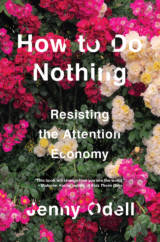 Jenny Odell's 'How to Do Nothing: Resisting the Attention Economy.' (Courtesy of Melville House)
That feels ridiculous to write, since I’d been looking forward to reading it since well before publication. As the artist behind projects like the ‘Bureau of Suspended Objects’ at the San Francisco dump and the mind-expanding essay There's No Such Thing As a Free Watch, Odell has long been one of those people whose grocery lists, even, I feel certain I would find scintillati ng.
But I was slammed: I had deadlines to meet, emails to send, and social obligations and/or networking events that all had a way of bleeding over into my downtime. As a full-time freelance writer, I always know exactly what’s in my checking account. And even on the best days, this knowledge forms a sort of cloud overhead, casting a guilty shadow of understanding that, at any given time, I really should be working.
I also have to keep up on the news, be on Twitter, promote my own work if I want anyone to see it. I’ve grown accustomed to the fact that a good deal of my work is simply selling myselfâ€"sorry, “brandingâ€â€"and also to the nonexistent line between my professional and personal lives. It all adds up to a sense of always being busy. Also, the new season of Queer Eye had just arrived on Netflix.
Near the end of the second week of Odell’s book sitting on my shelf unopened, after a particularly unproductive dayâ€"the kind where the guilt over how little you’ve accomplished becomes an activity in and of itselfâ€"I went to a Mission District bar to see a friend’s band play. A typical Thursday night for me, except that I was 26 weeks pregnant, and looked it, and it turned out this show meant seeing a handful of people I hadn’t seen in a while, people who were not expecting to find me in such a state.
It was a great show, and I stayed until the last band had played the last note, generally behaving the way I always do at shows (minus a beer or two). At some point before I split for home, a musician friend who’d just been on stage gave me a hug and, eyeing my belly, said with innocent admiration that it was great to see me “out.†He seemed amused that I had even danced a little.
He meant nothing by it, yet the defensiveness that rose up in my throat was immediate. I was still me. Why wouldn’t I be out?
But the next day, as I bristled at his implicationâ€"I’m pregnant, I don’t have polio, I said to a friend over brunchâ€"I also couldn’t ignore the hatch door of possibility that had just swung open before me. People’s expectations for me had changed shape overnight.
I was pregnant, and with this fact came coded privileges. I had an excuse to go home early. I had an excuse to stay home in the first place. Because I was visibly “working†to create a human being, and doing it around the clock, I realized I had a limited-time-only passâ€"for a strange, temporal periodâ€"to do nothing else at all.
“At some point, I began to think of this as an activist book disguised as a self-help book,†writes Odell in How To Do Nothing’s introduction, a disclaimer that becomes unnecessary midway through the first chapter. Despite the book's title, anyone hoping for Wikihow-style bullet points about how to achieve enlightenment via inaction should look elsewhere. (Perhaps to Wikihow. Those illustrations!).
What Odell delivers instead, over the course of six chapter-length essays, is a labyrinth of questions about the usefulness of a life focused on "usefulness"â€"and what gets overlooked in a culture obsessed with productivity.
There's a reason, Odell suggests, that so many of us increasingly spend our days feeling like our brains are occupied by tiny wind-up monkeys playing cymbalsâ€"overstimulated but unfocused, lonely while supposedly more connected than ever. How To Do Nothing is a call to arms about the fractured state of human attention (a commodity Odell paints as our most precious resource), and what’s at stake for society when we allow it to be bought and sold by companies whose profits depend on our willingness to stay addicted.
To do this, Odell finds inspiration in the bioregionalism movement; touches on organized labor and the political potential of work stoppage; traces the history of communes and other forms of physical escape from the rat race and their through-line to modern “digital detox programs,†noting the pitfalls of each; looks to trees as role models for passive resistance; and outlines the bubble effect of online communities like Nextdoor (in contrast with, literally, having dinner with one’s neighbor next door).
Odell has a historian’s obsessiveness for the provenance of her ideas, and she pulls from a broad swath of teachers, including Plato, Audre Lorde, the third-century hermit St. Anthony, the fourth-century philosopher Epicurus, the technology ethicist James Williams, Herman Melville’s Bartleby the Scrivener, a slew of 20th and 21st century performance artists, Rebecca Solnit, and Tom Green (who, it turns out, invented planking back in 1994).
A hundred different trend stories can tell you too much screentime is bad for your brain. Intellectually rigorous and quietly radical, Odell’s book extrapolates those studies outward to argue that what's detrimental for one's personal health is, potentially, fatal for one's community. When we forfeit our ability to interact meaningfully with our environment and with other human beings, she argues, we lose the very fabric of society: the means to truly connect and support one another, to organize, to make meaningful social and political change.
The antidote she suggests is both simple and challenging: a reclaiming and redirecting of attention to our literal surroundings. The book forces some practice on this; at times, the reader is made to slow down to the pace and character of a physical space, and the reading itself becomes a trust fall of observation. We have to believe that the description of a dam or a type of bird will not only “pay off†in terms of a larger point. It is, in fact, the larger pointâ€"to notice how the world opens up when you step back from the “financially incentivized proliferation of chatter†that makes up the digital age, and simply see what’s around you as worthy of attention.
To that end, we go birdwatching in the Oakland hills, sit in the Morcom Rose Garden, and explore the topography of Odell’s native Cupertino via its creeks and office parks. In one example of an attention “exercise,†Odell recalls going to see the San Francisco Symphony perform John Cage’s Song Books, an experimental piece made up of ambient sound, in which the musicians dress in plain clothes and futz around with everyday, noise-making props like a typewriter, a set of cards, and a blender.
In the absence of music, the audience’s uncomfortable throat-clearing and chair sounds all build tension, becoming part of the score, until conductor Michael Tilson Thomas uses the blender to make a smoothieâ€"then takes a sip and makes a satisfied face. “After that, all bets were off, with laughter tumbling down from the seats toward the stage and integrating itself into the piece,†writes Odell. Then:
More than just the conventions of the symphony hall were broken open that night. I walked out of the symphony hall down Grove Street to catch the MUNI, and heard every sound with a new clarityâ€"the cars, the footsteps, the wind, the electric buses. Actually, it wasn’t so much that I heard these clearly as that I heard them at all. How was it, I wondered that I could have lived in a city for four years already… and never have actually heard anything? For months after this, I was a different person. At times, it was enough to make me laugh out loud.
The type of heightened awareness she’s describingâ€"not just of her surroundings but of her own everyday reality as a construction, something malleableâ€"is a state I mostly hear people talk about as the result of either psychedelics or a disciplined meditation practice, or both. The suggestion that each of us already has what we need for this in our brainsâ€"that such a shift in perception might be possible through simply, consciously taking back our attention from the corporate forces working to drain itâ€"is nothing short of exhilarating.
I mean: You’re telling me that if I retrain myself not to look at Twitter 32 times a day, I might be able to go on a walk and look at trees and hear birds and notice the hum of the ecosystem and tap into the fact that everything in the world has a secret life and pulse that’s always there and that everything’s connected and technically I’m part of it? And that it’s simply up to me to remember and keep that front and center (instead of thinking about who shared my latest story on Facebook or what Ariana Grande said about Jim Carrey or whether or not I should cancel my ClassPass membership) and that in so doing I would actually be fighting back against the creep of technofascism and resisting capitalism’s hold on the most vital and wild aspects of humanityâ€"and that all of that is possible without drugs?
It’s hard to put into a hashtag. But it sure beats anything I ever learned from D.A.R.E.
As I write this, I’m well into my third trimester, and I’m just getting used to the ways it’s changed how I move through the world: walking down 16th street, I’m met with a warm, protective nod from the older man smoking outside a bar at 1pm on a Tuesday, as opposed to a lecherous comment. Women with babies offer me conspiratorial smiles. In the past 48 hours I’ve had two different groups of people make a fuss about insisting I sit down on the bus. (I’ve chosen to take this as reassurance that chivalry is alive and well, and not as “You look like you might go into labor any minute and I’d prefer you not be standing next to me when you do.â€)
Still, more surprising (to me) are the changes in how I treat myself: basic tenets of “self-care†that have always eluded me became unavoidable overnight. My needs and responses to them have become animal-like, elemental: when I’m tired, I sleep. When I’m hungry, I eat. I have to work, so I work, and I love my friends and family, so I see my friends and family. I show up for my community when I want or need to. But there’s very little striving. I want to say I don't feel tethered to notifications the way I'm used to. When I don’t want to do anything, I really don’t do anything. And I don’t feel guilty about it. It’s very new and it's very, very weird.
It’s surely no coincidence that this newfound ability to “listen to my body,†to use more terminology that grosses me out, arrived at the same time I stopped being able to bulldoze over physiological instincts with quick fixes: tired=more caffeine, stressed out at the end of the day=have some whiskey, and so on.
But it also occurs to me that I’ve truly never felt allowed to indulge in the possibility of non-productivity before. It definitely occurs to me that I only feel this way because it’s temporary.
The thing about refusal to participate as a method of resistance, of courseâ€"whether mentally, from the news cycle, via quitting social media, or physically, from urban society, by splitting for a cabin in the woodsâ€"is that it necessitates a certain level of privilege. (Thoreau only spent one night in jail, after all, because some rich aunt paid his back taxes.)
Once you start seeing rest as a luxury good, it’s everywhere; most recently, I loved this piece on shade in Los Angeles as an index of inequality. And when it comes to mental rest, we all reflexively know the prerequisites: in the first months of the Trump administration, when people mentioned in an offhand way that they just “couldn’t read the news anymore,†those people were generally not undocumented immigrants or Muslims or trans womenâ€"members of groups for whom the stakes of inattention are life and death.
Odell knows this, too, and she owns, among others, the privileges that made it possible for her to even write this book. Yet in so doing, she winds up back at the labor movementâ€"perhaps the last tangible win for the working class in Americaâ€"and reminds us that the “eight hours of work, eight hours for rest, eight hours for what we will†was a campaign “about a demarcation of timeâ€:
The removal of economic security for working people dissolves those boundaries... so that we are left with twenty-four potentially monetizable hours that are sometimes not even restricted to our time zones or our sleep cycles.
In a situation where every waking moment has become the time in which we make our living, and when we submit even our leisure for numerical evaluation via likes on Facebook and Instagram, constantly checking on its performance like one checks a stock, monitoring the ongoing development of our personal brand, time becomes an economic resource that we can no longer justify spending on “nothing.†It provides no return on investment; it is simply too expensive. This is a cruel confluence of time and space: just as we lose noncommercial spaces, we also see all of our own time and our actions as potentially commercial.
It’s not an answer to the privilege question, to be sure. But I took a photo of this passage, and since finishing the book, these words have haunted me. They bite at my ankles when I compulsively check Twitter before bed. They raise their eyebrows when I click on a shoe ad on Instagram, and for the next week, the app seemingly chases me around my own home, asking: are you sure you don’t want those shoes? How about these? (Insert Radiohead lyrics here.)
The problem is, of course, we’re all busy, and concepts like the ones conveyed in How To Do Nothing are hard to keep in focus. As I write this, I’m staring down three other deadlines and an overgrown swamp of an inbox, and I need to get groceries, and have I mentioned freelance writers don’t exactly get paid maternity leave? I am staggeringly privileged compared to many people in America, but like many people in America, I cannot afford to stop working around the clock.
Odell also makes a compelling case that we can’t afford not to. I am curious to see if and how this argument lands differently for me when I stop being a person with a highly visible hall-pass-to-do-nothing and instead become a Working Mother, a category of human I have come to understand is not exactly pampered by the infrastructure of American capitalism, nor encouraged to go on long, reflective nature walks alone. Similarly, I find myself wondering how this book would read if I were a person whose work involved 10 hours of daily manual labor, as opposed to sitting in front of the internet all day, and then wondering why my leisure time felt so familiar.
But for me, for nowâ€"and, I suspect, for many of usâ€"it’s a huge shift to even ask some of these questions in the first place. After reading How To Do Nothing, I have a newly heightened vigilance about what counts as work, and about whom we’re working for, exactly, when we open up Instagram for the 10th time that day. And a new awareness of the lessons that dwell in the realm of negative possibilityâ€"of doing nothingâ€"which are, of course, always there waiting. They require only that we be still.

0 comentários:
Postar um comentário