quinta-feira, 28 de fevereiro de 2019

image source: https://pixabay.com/en/road-start-beginning-intention-368719/

Speaking for several entrepreneurs, I'm sure that Paul Graham is one of the most influential people in shaping today's technology industry. Through his writings and his Startup Accelerator YCombinator, he has helped shape the modern technology ecosystem — especially among startups — about as much as Steve Jobs and Apple helped shape hardware. Or Microsoft shaping software. Not only has YCombinator funded and mentored thousands of companies in navigating through their growth, they also give priceless written knowledge to the broader community of entrepreneurs and startups. Companies they have funded include Reddit, Airbnb, Dropbox, Coinbase, DoorDash, Twitch, and many more.

Their content is also top notch. In an age of forgetfulness and information overload, Paul Graham's essays have stood the test of time and they continue to be some of the most comprehensive ways around the wild west of technology, especially software. The way Paul Graham writes has a unique style — he gets down into the gritty details without getting you lost. Then he brings you back up to see the big picture, helping you connect the dots the whole way. In this series I will highlight the best of several of his articles, starting at the very beginning, perhaps his most classic essay: How to Start a Startup.

1 — How to Start a Startup

Right off the bat, the first paragraph hits hard in its simplicity and succinctness (emphasis my own).

You need three things to create a successful startup: to start with good people, to make something customers actually want, and to spend as little money as possible. Most startups that fail do it because they fail at one of these. A startup that does all three will probably succeed.

That's it? In a world of startups and small businesses where the majority shut down within their first year, and only 10% end up making any significant return, this seems like a very bold statement in beating the averages, but as he goes on, he deliberately proves each of the above points in his thesis, and you realize he is right. He breaks up the rest of the essay into about 6 major sections: "idea", "people", "what customers want", "raising money", "not spending it", and "should you?". Among all of these, the idea section is noticeably the shortest. The introductory sentence reveals why.

In particular, you don't need a brilliant

idea to start a startup around.

Huh? But most people think the idea is everything!! He acknowledges this in another essay: startups are counterintuitive. He then provides more detail on how little an idea is worth in the market and finishes with the solution to this dilemma of what really matters.

What matters is not ideas, but the people who have them. Good people can fix bad ideas, but good ideas can't save bad people.

Ok, so it's the people that really matter. The people who have the ideas. But what kind of people should they be? This includes the founders, the early team members and employees. He goes on to describe the team at his startup.

Almost everyone who worked for us was an animal at what they did. The woman in charge of sales was so tenacious that I used to feel sorry for potential customers on the phone with her. You could sense them squirming on the hook, but you knew there would be no rest for them till they'd signed up.

Tenacity. A required characteristic among the top performers. The rest of the section includes tips on how to recognize top performers of other professions, namely programmers. It also includes tips on how to find these people, work with them, and finally a general makeup of the initial group's roles. In discussing the interactions of the early team and the general makeup of their roles, Paul Graham arrives at the most important role of any business person working at the startup: understanding users, the main topic of the next section.

This section on "What Customers Want" is clearly the most important of the essay considering how lengthy it is. I would even go so far as to say that this is the central thesis of the essay and everything else after that is only there to satisfy the curious entrepreneur about the process of raising money and managing it. In this section, PG is also his realest / harshest self. He doesn't mince words about why most startups fail.

In nearly every failed startup, the real problem was that customers didn't want the product. For most, the cause of death is listed as "ran out of funding," but that's only the immediate cause. Why couldn't they get more funding? Probably because the product was a dog, or never seemed likely to be done, or both.

So the product is really important. To drive the point home, PG uses the restaurant analogy that no restaurant with great food went out of business. He also really hits home that in order to make something people want, founders and "hackers" (software developers) should try very hard to be empathetic and focus on ease of use.

It's worth trying very, very hard to make technology easy to use. Hackers are so used to computers that they have no idea how horrifying software seems to normal people

I write software and yet most software still seems horrifying to me. This comment rings especially true for people working on User Interfaces and consumer products. There's even more of a danger in trying to go after products that need large numbers of consumers to be successful. The chances of those succeeding is even lower because lots of people try to make the next Facebook and also because consumers today have no shortage of entertainment options. The best advice that PG offers to this dilemma is to focus on niches.

Since startups make money by offering people something better than they had before, the best opportunities are where things suck most.

Well said. Despite over half the world being connected to the Internet today, most internet software still sucks. This is especially true for software related to productivity or work. There are also several niches that continue to get worse, like the recent example of decreasing interest in Tumblr, which has left several artists without a creative means of expression. This has led to better designed platforms like Medium thriving because of their excellence in a particular niche like writing.

The rest of the section has great advice on things that you can do to understand your users better. PG also discusses marketing and segmentation. Then he justifies why it's better to start in a niche, even if your end goal is taking over the whole market. This is a well-documented business strategy called the Blue Ocean Strategy, popularized by a book of the same name.

In technology, the low end always eats the high end. It's easier to make an inexpensive product more powerful than to make a powerful product cheaper. So the products that start as cheap, simple options tend to gradually grow more powerful till, like water rising in a room, they squash the "high-end" products against the ceiling. Sun did this to mainframes, and Intel is doing it to Sun. Microsoft Word did it to desktop publishing software like Interleaf and Framemaker. Mass-market digital cameras are doing it to the expensive models made for professionals. Avid did it to the manufacturers of specialized video editing systems, and now Apple is doing it to Avid. Henry Ford did it to the car makers that preceded him. If you build the simple, inexpensive option, you'll not only find it easier to sell at first, but you'll also be in the best position to conquer the rest of the market.

Not only does this paragraph offer solid business advice, its tone is also one of my favorite parts about Paul Graham's philosophy on startups. It is the exact opposite of what many people's perception of the technology industry is — large companies that control the market and take all the profits. In fact, Paul Graham advises entrepreneurs to make simple, inexpensive products that can help users who are currently having a terrible experience. This philosophy is at the center of a happy intersection of doing something you like, getting paid well for it, and having it improve a currently broken aspect of the world.

In a very real sense, Paul Graham's writings have provided us the satirical comedy of the show Silicon Valley. He is the reason why so many entrepreneurs claim to be focused on "making the world a better place", and genuinely believe it. The case also very strong for a well-run startup company making the products described above actually making the world a better place with affordable, easy to use products that are solving a problem. But there's a catch — making a startup like that is an excruciatingly difficult and slow process. Despite there being an overabundance of knowledge and tips, entrepreneurs still need all the help they can get.
Thursday, Elle UK published a personal essay by Taylor Swift online, written for the magazine's Music Issue (out March 7), of which she's also the cover star.

In the essay, Swift discusses her relationship with pop music and names songs that resonate with her. She, too, use to scream out the lyrics of "I Write Sins Not Tragedies." 

Stars, they're just like us.

RELATED: Will Smith launches "Bucket List" web series on Facebook Watch | Fans of "The Notebook" are mad because Netflix is streaming an edited version in the UK

The article dropped in the midst of speculation on when Swift would release her seventh studio album, aka TS7.

Over the past week, fans have been freaking out at possible clues on her Instagram that new music is coming soon. Fans have noticed she's changed her aesthetic and seems to be counting down to something. What. Could. It. Mean.

Then Swift acknowledged the rumors, without really acknowledging them, by captioning a 'gram of her cat Meredith with "She just read all the theories."

So why would the star, who's been incredibly private lately, suddenly start posting so much on Insta? And why would she grace the cover of a magazine/write for one when she's (seemingly) not promoting anything? Her last album, "Reputation," came out 2017.

It would make sense if she was going to drop new music very soon.

While we wait for TS7, we can keep ourselves preoccupied by constantly refreshing her Instagram listening to all the songs Swift mentions in her essay.

They're listed below, and definitely make a pretty good playlist.

"Cowboy Take Me Away" by the Dixie Chicks "I Write Sins Not Tragedies'" by Panic! At The Disco "How to Save a Life" by The Fray "Breathe (2AM)" by Anna Nalick "The Story" by Brandi Carlile "You Learn" by Alanis Morissette "Put Your Records On" by Corinne Bailey Rae "Why" by Annie Lennox "In My Feelings" Drake "Closer" by The Chainsmokers ft. Halsey "Havana" by Camila Cabello

Follow Sinéad & PhillyVoice on Twitter: @sineadpatrice | @thePhillyVoiceLike us on Facebook: PhillyVoiceAdd Sinéad's RSS feed to your feed readerHave a news tip? Let us know.

quarta-feira, 27 de fevereiro de 2019

I've always enjoyed flipping through pictures and quotes from "Humans of New York." It's a rare opportunity to get to peer into the window of a person's private life. Whenever I allow myself to break that barrier, and truly get to know the person next to me, I'm often met with a better understanding that I am not alone. I wanted to explore more of that through this photo essay by shedding a light on some of the lives on campus.

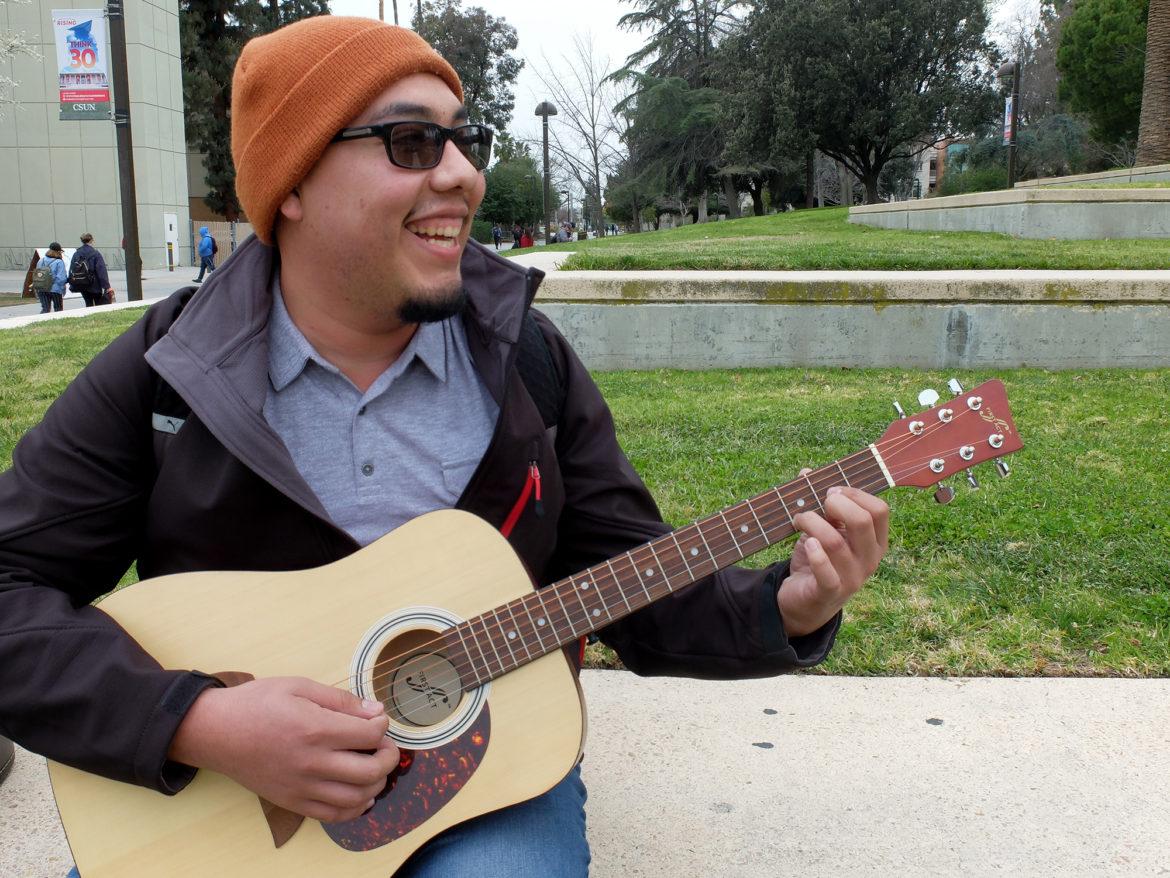
DSCF7863.JPG "My mom has always been the driving force of my family. No matter what she was always there for us. She has taught me to be a better person. A lot of people would confuse my behavior as being 'too effeminate' or something but I think it's more along the lines of I know how to treat people with respect, and I think that that's one of the more important things to learn from your parents is how to respect people. My mom is the most kind hearted person I know and that's how I aspire to be."

- Noel Hernandez, 25, CIT major Photo credit: Emmanuelle Roumain

DSCF8319.JPG "I'm living in Los Angeles for the first time. I'm from Germany and I love it here. Everything is different, especially the school system. Here we're doing more practical things like interviewing, taking pictures and videos. In Germany we mostly just sit in class and listen to the teacher. I like the weekly assignments they give you here which makes you study during the week. In Germany you just have an exam at the end of the semester but no one forces you to do anything. Here I have to do everything during the week. You have to be a lot more disciplined in Germany if you want to do well."

- Melina, 24, journalism and business communications major Photo credit: Emmanuelle Roumain

DSCF7793.JPG "I don't really have a well-structured study life. I'm on the CSUN ice hockey team and we have practice two days a week, and then travel to wherever our games are so I usually will study on the plane or on the bus, or right before my classes like I'm doing now. I've been playing ice hockey since I was nine, but I'm keeping it a hobby. Most players start when they're five or six if they're wanting to do it professionally. I have a couple of jobs in mind. I was looking at being a coast guard, or a physical therapist, or I could be a beach lifeguard. I feel like there are a lot of opportunities I can choose from."
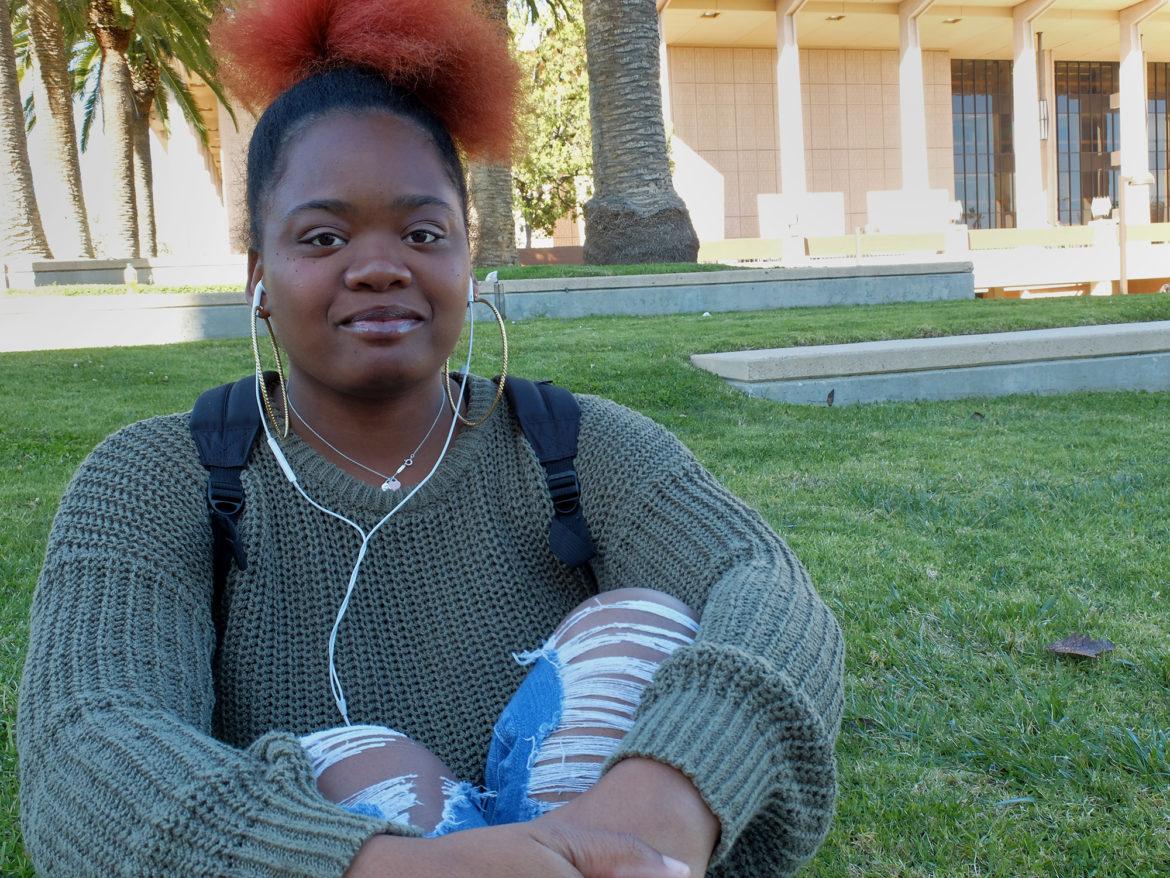
- Quentin Abaya, 21, kinesiology major Photo credit: Emmanuelle Roumain

DSCF8338.JPG "I've always had a passion for acting. I love entertaining people and making people laugh and smile. I just love watching shows and thinking 'I can do that.' When I saw the show 'A Different World' it made me realize how different African-Americans are from other races, what they go through. The show made people open their eyes and realize, 'Oh this is going on in our world,' it taught that we have to take a stand for what we want, and that made me want to be an actress more because it makes me feel like I can change the world."
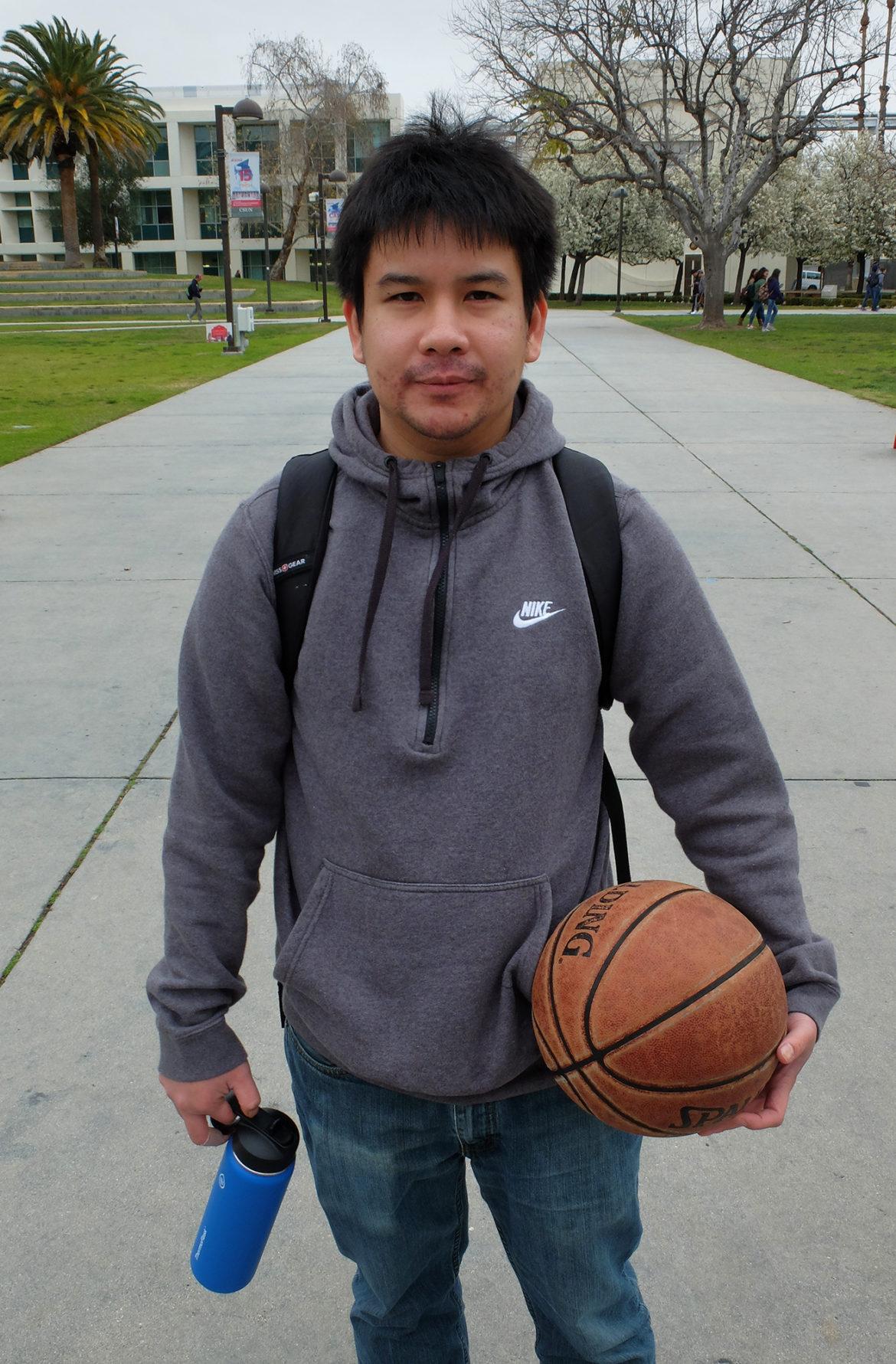
- Kyla Owens-Woods, 19, theatre major Photo credit: Emmanuelle Roumain

DSCF7834.JPG "When I was nine years old both of my brothers died the same year. My younger brother died first from leukemia. He was three years old at the time, and then six months later my older brother got into an accident. He got hit by a fast car. I was the middle child. I stopped going to school for almost a year. My parents, especially my mom, helped me cope with it by talking to me a lot. It has shaped me in a lot of different ways. I'm more compassionate toward other people. It doesn't make me feel emotional when I think about it now but, before, it was terrible. It's a long process, I've kind of moved on, but it's still there."

- Nico Rome, 24, CIT major Photo credit: Emmanuelle Roumain

Jessica Alonzo"My father came here from Mexico pretty much with nothing. He started from the bottom and I've seen him prosper a lot in his work. I look up to him a lot, he makes me want to be more like him. My ambition grows every time I see him grow and it mak es me just want to finish school and make him proud and be able to say, 'Thanks to you I made it this far.' I'd like to give back to him eventually. Sometimes a part of me tells me he probably wishes I was a guy. He puts me down sometimes, and I try not to let him see that. It just makes me want to go out there and do something with my life and prove him wrong. He always tells me life in his times life was so hard at my age and I'm like 'Okay well we're not in your times, and I'm a girl, so things are different.'"
- Jessica Alonzo, 22, health admin major Photo credit: Emmanuelle Roumain

In light of this week's events, I offer an essay adapted from an old homily, instead of my weekly podcast.  Countless Christians have prayerfully tuned in to watch the direction that the Methodists have taken. Traditionalists may have won a victory yesterday, although I did not see anyone taking a proverbial victory lap.  The reality that many people woke up with this morning is that there is an entire denomination to save, which may be fracturing over these issues.  Whole people groups are hanging in the balance.  Is the fellowship breaking?

All the nations will be gathered before Him, and He will separate them one from another, as a shepherd divides his sheep from the goats.  And He will set the sheep on His right hand, but the goats on the left.  Matthew 25.32-33, NKJV

i. We think primarily of the individual

We think of individuals facing judgment.  Western society trains us to think in terms of individuality.  We think of individual responsibility.  However, I think it is curious that Jesus begins this Last Days judgment scene with the word "nations."  In the Greek, this is the word ethnos.

Nations does not mean countries of land.  We typically think of nations as America, Canada, Mexico, etc.  Yet in the Bible, and in those days, nations are entire people groups.  This is easy to remember, because our words ethnic and ethnicity are from the word nations, ethnos.

It is interesting that Christ calls forth the nations.

ii. Entire people groups are going to answer to God

Let's make this practical.  This was a popular phrase in the '80's, "Oh c'mon!  Everybody's doing it!"  I don't know how that became such a popular phrase.  That may be true to a degree, but according to Scripture, if entire groups of people are doing it out of line, they're going to answer as a people.  So everyone that's doing it is going to pay for it.

We are not just talking about cultural distinctions.  This parable is talking about behavioral distinctions as well.

Jesus speaks of this judgment of nations in other Texts.  He pronounces judgment on people groups in Matthew 11 and Luke 10.

iii. Jesus preaches a sermon of "Woes" to entire cities

Then He began to rebuke the cities in which most of His mighty works had been done, because they did not repent: "Woe to you, Chorazin! Woe to you, Bethsaida! For if the mighty works which were done in you had been done in Tyre and Sidon, they would have repented long ago in sackcloth and ashes. But I say to you, it will be more tolerable for Tyre and Sidon in the day of judgment than for you. And you, Capernaum, who are exalted to heaven, will be brought down to Hades; for if the mighty works which were done in you had been done in Sodom, it would have remained until this day. But I say to you that it shall be more tolerable for the land of Sodom in the day of judgment than for you."  Matthew 11.20-24, NKJV

Jesus is calling them out, saying they will face judgment as a city.  He runs with the idea that You had a choice as a region and as a city.  So you could have repented, but you didn't.  On the other hand, Jesus plants the seeds for the Gospel truth that whole cities can repent.

JVI | praying over town | 09.17.18iv. Jesus compares impenitent cities to Old Testament cities

Christ keeps the truth in front of us that we have a responsibility to reach entire cities with the love of God.  He says to Chorazin and Bethsaida that He has shown up and shown them miracles, but they did not repent.  He says that if the same miracles were performed in the Old Testament region of Tyre and Sidon, which is compared to the throne of Satan (Ezekiel 28), Tyre would have repented.  Jesus says that if the miracles that He did in Capernaum would have been done in Sodom, they would have repented (Genesis 19).

As one who has spent much of his life in the Bay Area of California, I have heard all the doomsday prophets speak of judgment.  I have even heard people predict that acts of God will destroy certain regions in the West.  I've replied many times that Jesus says that if Tyre, Sidon, and Sodom would have seen the miracles of Christ, they would have repented. v. Without excuse

So on judgment day when some cities stand before God, guess who will have no excuse?  The Church, because we didn't reach the city with the miraculous power of God.

There is no sin that God cannot forgive and change.  It just takes the love of God in action and the signs of the Almighty.  Whole people groups are looking for a supernatural experience.

I consider it to be hypocritical if Christians condemn certain lifestyles, and then allow others to remain in the church who are engaging in illicit sex.  We don't seem to have a problem helping people overcome certain forms of sexual sin, but we cast nothing but judgment on other forms of perversion.  As Christians, we are without excuse if we do not share the transformative Gospel with all.  God only blesses sex in a marital union between one man and one woman.  I'm thankful to be part of a fellowship that recognizes this Biblical truth in our governing documents.

If we share the Gospel from a visible community of faith, it is very attractive.  Whole people groups are looking for a vibrant, loving, transformative community.  The book of Acts bears this out as thousands come to the Lord in a moment.  Whole households make decisions.  Everyone on the island of Malta joins the Body of Christ.

vi. People groups approach the throne

In the Parable of the Sheep and the Goats, whole people groups approach the throne.  They give some sort of account collectively.  Then the peoples who have lived together in communities, tribes, and even congregations are separated as sheep and goats.

They may answer as a people . . . but then they will be separated like sheep and goats.

I remember an elementary school field trip to a goat farm.  As soon as the class entered the big holding pen for the goats, I was pretty excited.  I can't remember seeing goats up close before.  Then it felt like someone hauled off and kicked me from behind.  I stumbled forward and tried to hold back the tears.  I turned around and no one was there, but a goat.  I was hurt . . . literally . . . and emotionally.  I've always loved nature and God's creatures.  I really wondered why that goat would do that?  What had I ever done to it?

I don't know how many times in the Church, I've got blindsided over the years.  Why would Christians do that?  What have I ever done to them?

vii. The sheep and the goats

With this theme that we are chasing in this essay, my experience leads me to believe that Christians who are judgmental over one issue, are judgmental over other issues.  However, Christians who are driven by the Spirit to seek lost souls always lead people to the Cross first, before explaining the Great White Throne Judgment.  Sin is sin.  There is no doubt, but we all start by laying our sins down at the Cross.

Are we meek and lowly sheep like the Good Shepherd (Matthew 11.28-30)?  Or are we ramming each other and locking horns all the time like goats?  Apparently, there are goats who mingle with the true flock of sheep, otherwise Jesus won't have to separate them in the Last Day.

Only the Shepherd knows the difference and He will make the final call!  Our Lord Jesus Christ, the Son of God, will separate the sheep and the goats.

Grace Brose of Box Elder is heading to Washington, D.C., to talk about the importance of agriculture ahead of National Ag Day, which is March 19.

Brose wrote the winning essay for a contest sponsored by the Agriculture Council of America.

The theme his year was “Agriculture: Food for Life. How does our nation lead the way?”

It gave high school students the chance to address how American agriculture feeds the growing population. Entrants chose to either write an essay or create a video. One written winner and one video winner were selected.

Brose will present her winning essay at the National Press Club event in Washington, D.C., March 14. There, she will have the opportunity to join other youth for a panel discussion on issues and challenges in agriculture.

“We are proud to give this year’s essay contest winners a platform that lets them share their ideas with a broader audience,” CHS spokeswoman Annette Degnan said. She also serves as board member of the Agriculture Council.

The Ag Day Essay Contest is sponsored by CHS Inc., National Association of Farm Broadcasting and Farm Progress.

Brose also receives a $1,000 prize.

The contests also named two merit winners who receive $100 and blog posts featuring their essays. They are Brody Allen Snook of Marseilles, Illinois, and Emily Li of Sugar Land, Texas.

This year’s Video essay winner, Jacob Kandell of Mason, Ohio, wins a $1,000 prize.

Agriculture: Food for Life

How Does Our Nation Lead the Way?

There's a little boy, out in the front yard with a beat-up toy truck, filling the back end full of dirt, only to dump it all out and start over again. Pretty soon that little boy is a teenager, and he finds himself trying to rock that old Ford out of some rut, thinking he may have underestimated how much it rained last night. In the blink of an eye, he's a newlywed, breaking ground on a two-bedroom, white-picket-fence dream. He's ready to plant some roots. Well, now that little boy is an old man, and in his two hands, you can see years of hard work and sacrifice. Every blemish is its own story. Those hands are strong enough to plow and plant, and sweat and bleed, yet gentle enough to raise a family.

That is the story of farmers and ranchers all across the country. That is the story of generations of my family, the reality of many of my fellow rural Midwesterners, and a great source of pride. That cannot be the end of the story, though. The world population is ever-growing, and those old men cannot plow and plant forever. Now is the time for my generation to step up and step in because agriculture is more critical than ever.

Agriculture is a science. Like any science, it is continuously changing. It is no longer just 80 acres and a dream. It is precision ag, genetically modified organisms, cover crops, no-till techniques, innovative pesticides, and more! Innovations in technology, transportation, architecture, and even medicine mean nothing when people are dying of starvation. The global population growth is not slowing down, and I am not exaggerating when I say being able to feed that population is paramount in sustaining life on Earth. The Midwest, the United States, and the entire globe must realize the importance of modern agriculture.

With that said, I am infinitely proud of the life my family has been able to build through the generations. I am proud of a farmer that will spend several months and thousands of dollars cultivating the ground, planting his crop, and watching it grow, only to have it blown away in a storm a few weeks before harvest. I am proud of a rancher that will be up multiple times in the night during calving season to check on his cows but still shed a tear watching a mama cow lay beside its stillborn calf. Most of all, though, I am proud that one day, I will be able to combine the traditions of my family with the needs of the world. That, indeed, is something beautiful.

Welcome to The Edit. Each week in our newsletter, you’ll hear from college students and recent graduates about issues going on in their lives. Sign up here to get it in your inbox.

Another Valentine’s Day has passed, which means it’s a good time to 1) buy candy and 2) start writing, because the Modern Love College Essay Contest is officially open for submissions.

If you are a frequent reader of the column or listener of the podcast, you know that Modern Love is home to some of the most moving personal essays in The Times. Now, college students, is your chance to submit your own story.

I talked to Daniel Jones and Miya Lee of the Modern Love team about what they’re looking for in submissions, common themes of young love and college students’ inevitable procrastination.

Robbie: How did the co ntest originate?

Daniel Jones: I wasn’t hearing from young writers, and I wanted to get great essays that would really define what relationships were for people that age. I put out a call for a contest and aggressively publicized it through emailing English departments nationwide and all that. It really paid off. I loved the material that came in and seeing the trends of what young people were dealing with.

Robbie: Is holding it in mid-February purely coincidental or is that a conscious decision because of Valentine’s Day?

Daniel: We had to find a time that was after winter break that would give enough time for students to write essays â€" they get five weeks or so â€" then for us to read all of them, edit and publish them while school is still in session. We time the announcement to Valentine’s Day because love is in the air, supposedly.

Robbie: What are you looking for in submissions?

Miya: We’re looking for essays that are representative of the bunch but also have a unique voice. We try to pay attention to trends when we’re reading. One year there were many essays about Tinder, so we wanted to make sure one of the finalists hit on using apps for dating.

Daniel: And we’re always looking for strong storytelling. A lot of students get the misimpression that we’re looking for an essay that defines what love is. They’ll start off with a dictionary definition and write five paragraphs. But it’s not an expository essay; it’s a narrative essay. It’s storytelling from their lives that makes a point about relationships today. It should convey that information through storytelling, not through argument.

Robbie: What common themes or trends have you noticed about mille nnial love?

Daniel: I’d say the most common overall theme is people trying to figure out how to find love without ever having to be vulnerable. I often get the sense that college students are piecing together the little parts of their love lives that they need. There can be sort of a dividing line between an emotional relationship and a physical relationship. It changes from year to year based on how people are communicating and where they’re finding these connections.

Miya: There are many more forms of relationships now. Polyamory is a big theme in this contest, and I don’t really remember it showing up as much in the 2015 contest.

Daniel: It seems like many young people are getting rid of old constrictions, but they aren’t sure what shape the new thing should take. There’s lots of discussion about labels and terminology. In a previous contest, so many e ssays were asking the question, “What are we? Is this a relationship? Is it not a relationship? Does it have a rule? Does it not have a rule?” There’s always a lot about college that’s experimental, and that’s good! It leaves a lot of room for confusion, but it also leaves a lot of room for good essay writing because people are trying to figure out what things are.

Robbie: Sometimes I feel like I need a dictionary to distinguish between all of the different terms we have for things, whether it’s “talking” or “hooking up” or “ghosting.”

Daniel: I remember reading a bunch of essays, I can’t remember how long ago it was, where no one really agreed on what “hooking up” was. They sort of assumed they had this language in common, but when they were really being honest they were like, “Is this hooking up? If you’re just like kissing, is that hooking up?”

Miya: We’ve also seen a lot of people talking about the impact of technology. Clara Dollar, who was a finalist in the last competition, wrote about her Instagram personality and how she was always trying to live up to that version of herself. In 2015, Davis Webster wrote about never meeting up with someone on Tinder, but having this kind of virtual relationship. So at one end of the spectrum you have this no-strings-attached hookup culture, and then on the other side you have people connecting emotionally in a virtual world, but never meeting up.

Daniel: It can be really hard to start over and reinvent yourself in college the way that many people used to because now your whole online presence trails along. Your followers are going to notice if you start to become a new person. There’s a self-consciousness about that. It also used to be that a lot of high school relationships would end when you went to college â€" that was it, you weren’t going to have a long-distance thing. Now a lot of people just transition seamlessly into long-distance laptop/phone relationships and often never question that they shouldn’t.

Robbie: What is the reading and judging process like? I read last time you all met up at the Seinfeld diner in New York.

Daniel: Most of it’s not that fun or glamorous. Much like reading for the regular column, which I’ve been doing for 14 years and Miya has been doing for four years, it’s really about immersing yourself in essay after essay and figuring out how much you need to read to give it a fair chance.

With the college contest we’re looking at 2,000 or more submissions, which we have to get through in about three weeks. With such a huge workload, we’re looking for some spark. It doesn’t have to be a p erfectly polished essay, but there has to be some vulnerability and an idea that we can grasp on to. We publish the winner and then if we have other good finalists, we’ll publish as many as five essays. So we’re also looking for a mix that can represent a breadth of experience. We wouldn’t run four essays that are all about Tinder, for example; we’d want to run essays that show different things.

Often writers are good at what they’re good at because they have distance from the subject matter, and they’re writing about something that they’ve been able to process for five years, or seven years, or 10 years. What’s so remarkable about the college contest is that students are writing about the time they’re in right now with that kind of intelligence and self-awareness. That’s what I appreciate the most and what I feel like I was not even close to in college.

Robbie: Ho w does reading all of these deep personal essays in such a short time period affect you emotionally?

Daniel: Part of it’s exhausting, but it’s also really inspiring. Some students aren’t able to articulate what they’re going through well enough for publication, but it’s impactful to read the things they’re grappling with, which are often really traumatic experiences. You can see them figuring things out about these really difficult experiences and coming out the other side of that through writing. That’s always inspiring to me.

Robbie: Anything else?

Daniel: Something like 80 percent of the submissions come in on the final day. Of that 80 percent, I think like 60 percent come in in the final two hours. College students and deadlines â€" it’s kind of hilarious. Maybe try to get it in before 11:58.

21 Sav age on ICE Detention, the Grammys and His Uncertain Future “My situation is important ’cause I represent poor black Americans and I represent poor immigrant Americans,” the rapper said.

YouTube Unleashed a Conspiracy Theory Boom. Can It Be Contained? What if stemming the tide of misinformation on YouTube means punishing some of its biggest stars?

Inside Trump’s Two-Year War on the Investigations Encircling Him President Trump’s efforts have exposed him to accusations of obstruction of justice as Robert S. Mueller III, the special counsel, finishes his work.

For a Black Mathematician, What It’s Like to Be the ‘Only One’ Fewer than 1 percent of doctorates in math are awarded to African-Americans. Edray Goins, who earned one of them, found the upper reaches of the math world a challenging place.

Life Without Plastic Is Possible. It’s Just Very Hard. Going plastic free starts with cloth bags and straws. Suddenly, you’re … making your own toothpaste?

Who’s Running for President in 2020? Who’s in, who’s out and who’s still thinking.

Robbie Harms is a contributor to The Edit. He studied journalism and economics at the University of North Carolina at Chapel Hill and later graduated from the University of Florida with a master’s in education. He now works as a fifth-grade teacher.

Intuition sometimes manifests as dreams. You can dismiss a given dream on a given day. But have you ever noticed patterns?

As in, re-occurring ones?

My entire life, I've had two kinds of dreams. First, something breaks into my home and attacks me. Never human. Sometimes it's a lion or another huge animal. Other times, a demon.

Second, I've dreamed about tornadoes coming after me. Sentient tornadoes. They started on the horizon. Now, they're right up close. At my office building. Are they trying to kill me, or tell me something?

For a while now, I've wondered.

Here's a radical idea. The thing in your dreams, the thing you fear, it's actually you. A version of your mind.

Not necessarily a demon as something you need to banish. No, and the recent sway is that you can never rid a demon.

They come for you, and take up residency.

Get used to your demon. It ain't going away. Hey, it might even be good for you, as long as you can train it.

opinion

Asbury Park Press

Published 6:15 PM EST Feb 26, 2019


There is no accounting for people's taste in movies. It's true with those who judge the Academy Awards and it's also apparently true with the winners in this month's Asbury Park Press essay and video contest. Among the favorites: "Napolean Dynamite," described by grade 9-12 winner Maxwell Brushaber as having "no overarching plot" and "no underlying meanings." Video winner Bradley Preiser was partial to Mean Girls." Other winners were taken with "Madagascar," "Legally Blonde" and Scooby Doo's  "Spooky Island."  Sit back with a bowl of popcorn and enjoy reading and watching their reviews. 

First place winner: Grades 7-8 

I'm not a movie person,

I'm a family person

A while ago I made a few rules about my writing.

1. I never write about politics.

2. I wanna enjoy what I'm writing about.

3. I try to be as honest as possible.

And I'll be honest, I looked at this prompt and thought, Well, that's just great.

I worried about breaking Rule #2; I'm just not that much of a movie person!

But the more I thought about it, there are a few movies I like.

"Mulan," "The Little Mermaid," and "Moana" are in Top Ten. But there are movies my siblings liked that I didn't. "Snow White" bored me. "Sleeping Beauty" freaked me out. And (please don't kill me Language Arts Period 8-9) I never really got into "Shrek."

If I had to pick one movie that towered above the rest, it would be "Lilo & Stitch." Probably because it was the first movie I ever saw, and to this day I run to the TV whenever the opening music plays.

I remember Mom putting on the movie to entertain the relatives. I never talked when I was little and froze whenever anyone talked to me, so, to everyone's surprise, I ran downstairs and copied the people on-screen, following their dance as best as a 2-year-old could. In the end, everyone cheered and I — noticing the people — screamed at the top of my lungs and was upstairs before you could say Experiment 636.

Heh.

The main reason I love "Lilo & Stitch" is "Ohana." Although I didn't understand most of the movies when I was young, I understood "Ohana."

For those heartless enough to have not seen the movie, Ohana means family. Family means nobody gets left behind. Or forgotten. 

And I don't think any movie can beat "Ohana." Even if Shrek and Darth Vader teamed up to beat Batman I'd still think "Lilo & Stitch" was better. 

 Family's what's important to me. Mom, Dad, my brother and sister, my dog, my cats, my chickens, my lizards, my fish, they  are what matters most. So before you beat me to death for saying that I liked "Shrek 2"  better than the original, consider this: I'm not a movie person! I'm a family person.

And I don't know what i'm talking about; I thought the "Star Wars" prequels were good. 

Mya BurgosMemorial Middle School

First place winner: Grades 9-12 

Can't beat 'Napolean Dynamite'

for lack of symbolism, meaning

"Can anyone explain what the symbolism in this film is?" My teacher asks. 

No, I cannot and no one else can because there definitely is absolutely no symbolism within this film. The director certainly had no underlying meaning or any intentions of telling a deeper story.

As an AP English student, I am so tired of analyzing novels, movies, articles, documents, speeches, essays, you name it. Name any book you read in high school, I'm sure I've read it too and I can tell you all about the proposed symbolism within it. "Catcher in the Rye?" Holden's red cap represents his innocence, of course. "Great Gatsby?" The green light in the distance represents Gatsby's unreachable dreams. Do you see what I mean? I just need something that has absolutely no symbolism to think about. That's why my favorite movie of all time is "Napoleon Dynamite."

For those of you who have never seen "Napoleon Dynamite" before and want to know what it's about, I can sum it up very easily: nothing at all. Well, not really. It's about a super awkward high schooler named Napoleon Dynamite and his equally awkward interactions. Napoleon's family consists of his internet-obsessed brother Kip, his rough grandmother, and his Uncle Rico, who is sure he can still make it in the NFL at his age. Napoleon also has a friend named Pedro who hardly speaks at all. With an all-star cast like this, how could you go wrong? 

It is this simplicity that gives this movie its charm. You do not have to be actively watching in order to enjoy it. In fact, you could probably watch any scene in isolation and enjoy it just as much as watching it in the movie.

There is no rhyme or reason as to why Napoleon or any of the other characters do the things they do. There is no overarching plot or problem that the characters must resolve. And there certainly are no underlying meanings. This is what makes the movie perfect in my eyes. But that might be what gave it a 64 percent on Metacritic. Either way, it is still my favorite movie of all time. 

Maxwell Brushaber

Point Pleasant Borough High School

First place video winner Bradley Preiser of Point Pleasant Borough High School won first place in the Student Voices video contest with his "Mean Girls" movie review. See his "Mean Girls" video at the top of story. Second place winner: Grades 7-8

Watching 'Madagascar' over

and again never gets boring

"The red night goblin is coming!" Lemurs run around in circles on the screen, crashing into each other and running into trees. Mya howls with laughter and then falls on the floor after forgetting to steady herself with her hand. 

"What's going on in here?" my dad asks as he pops his head into my room. I try to explain, but I can't. Between Mya on the floor, the popcorn all over the place, and my dad's confused expressions, I can't control my laughter. He rolls his eyes before finally leaving the room. I look down at Mya, who, after recovering from her fall, is now eating popcorn off the floor, and I fall off the bed myself. Ali, my sister, who has been sitting in the hammock and observing us the whole time, rolls her eyes and goes back to cramming goldfish into her mouth.

"Madagascar" is one of my favorite movies because of all of the memories I have watching it. I have watched it with my friend Mya multiple times, and it's one of the only movies we don't get tired of. I have also watched it on ski trips, at friends' houses, and on family movie nights. I like how it has a happy ending (like most movies) and it's funny without ever getting boring. If I could choose one movie to watch for the rest of my life, I would choose this one because it's a funny and upbeat movie.

"That was so sad!" Mya wails from her spot on my floor. She made a point that she was too lazy to get up, so I took over the bed. I looked up at the screen again, and there the lemurs (they look like monkeys) are, ice skating with banana peels. 

 "They built a snowman on a tropical island, how is that sad?" I ask. She doesn't say anything. 

"That was fun, we should do this again soon," Mya says. Ali nods. 

"Aren't you tired of this movie?" I ask her. Mya shakes her head. "okay," I say. 

Kylie McLaughlin

Memorial Middle School

Second place winner: Grade 9-12

Elle from 'Legally Blonde'

served as my inspiration  

Anyone who has survived the college application process can tell you how difficult it is to sell yourself in 650 words. I found myself in this exact position, sitting slumped on my couch for hours upon end, staring at an empty screen with a complete sense of loss. Who do I need to be in this essay?

Struggling for the answer, I attempted and failed to keep myself awake to finish, or even just start, the essay.

When I woke up, the first words I heard were: "Oh, hi! My name is Elle Woods." Rubbing my eyes, the image of the "Legally Blonde" fashion and law student, Elle Woods, slowly materialized. 

"And for my admissions essay," she continued, grinning at the camera with cherry red lipstick, "I'm going to tell all of you at Harvard why I'm going to make an AMAZING lawyer."

I cocked my head and turned up the volume as I watched Elle govern her sorority with class, recall the events on "Days of Our Lives" with finesse, and use legal jargon with grace. By the end of her clip, I was not only mesmerized, but inspired. 

While the tale of Elle taking Harvard Law by storm is fictitious, we can all stand to learn something from her success. Elle, aware of her strengths, chose to lean into her personality, making her application stand out in all its bright-pink glory. 

Essentially, Elle is completely, and unapologetic, Elle. By recognizing her self worth and taking pride in who she is, Elle sells herself, without selling out. Thus, I realized that the essay was not just a chance to explain why I should go to college, but a chance to explain who I am. By simply being Stephen, I would stand out among the rest, and draw attention. 

After writing my essay, submitting the application, and receiving a letter in the mail, my family huddled around the table, waiting anxiously for me to open it.

After ripping the envelope, and staring at the letter for a solid minute, my mom asked quietly, "Well?"

I looked at her, smiled and replied, "Excuse me, I have some shopping to do."

Ever since, I have held a special place in my heart for Elle, and "Legally Blonde."

Stephen Crafton-Tempel

Freehold Township High School

Second place video winners   Third place winner: Grades 7-8

Everyone can relate to 

'Ferris Bueller's Day Off'

In the words of Ferris Bueller, "Life moves pretty fast. If you don't stop and look around once in a while, you could miss it." This is what every high school student strives for: to live life in the moment. In the movie, "Ferris Bueller's Day Off," Ferris Bueller, Cameron Frye and Sloane Peterson seize the opportunity to skip school and go into the city of Chicago. However, the riotous journey of trying not to get caught, pretending to be sick, and having numerous people cover for their lies turns out to be one of the best days of their lives.

This movie is by far my favorite movie. Between the comedy and musical skits, it embraces everything I enjoy in a movie. My brother and I are notorious for quoting this movie. From the economics teacher saying, "Bueller, Bueller, Bueller, Bueller" in his flat monotone voice to Bueller saying "Anyone, anyone," in that same voice. To the girl in homeroom saying, "My best friend's sister's boyfriend's brother's girlfriend heard from this guy who knows this kid who's going with a girl who saw Ferris pass out at 31 Flavors last night. I guess it's pretty serious." This just sets the tone for a great evening of laughter. My parents often say they can even "relate" to the movie. How scary is that? It is often a family favorite movie. 

I am able to watch this movie over and over and never become tired of watching it. There is always a new angle, phrase or detail to be seen. All in all, the presence of the lack of generational change proves that no matter what generation, students will always be looking for a way out of anything. No matter what the task may be. 

Third place winner: Grades 9-12

'Mary Poppins' brings me

back to my childhood

When I was younger, I watched strictly one movie, "Mary Poppins." In fact, I watched the VHS tape of it so many times that when it broke and we could not find another copy, I made my mom rent it from the library every day for months until we bought a DVD to watch it on. It was not that I refused to watch any other movies or that my parents did not let me. I simply had no interest in watching anything less supercalifragilisticexpialidocious.

I remember that during this phase my family went to Disney and I had the opportunity to meet the nanny in the flesh. She kissed my cheek and it left a scarlet stain. As a 3 year old, I thought my life was complete. For three days, I refused to wash the right side of my face until I unwillingly was forced to. 

I fell in love with Mary Poppins the first time I saw her descending from the clouds by her umbrella, becoming absolutely infatuated and obsessed. I even asked my parents if they could invite her to play with me. I wanted to experience my own version of Mary Poppins. I wanted to have tea parties on the ceiling with Uncle Albert. I wanted to jump into chalk drawings. I wanted cleaning my room to be an amusing game. Most of all, I wanted to experience the magic. 

Next, in third grade, I decided to be Mary Poppins for Halloween. I proudly marched through my school's Halloween parade, red carpet bag in one hand, parrot umbrella in the other. 

My mom had dressed me head to toe in her iconic navy dress suit — gloves, hat, scarf and all — looking practically perfect in every way.

"Mary Poppins" has always been a part of my life. As I watch the movie now as a teenager, the magic has never disappeared. I cannot help but act in the same way that I did as a toddler — grinning ear to ear and captivated by the screen. The film is one of the few incredible movies able to make anyone reminisce and return to their childhood again. I know in my future as an adult that I can always experience the same enchantment I did growing up.  

Ella Van Benschoten

Point Pleasant Borough High School 

Third place video winners Honorable Mention Winners: Grades 7-8

Mary Cook, Grade 7, Memorial Middle School, Teacher: Ellen KeelanShelby Schwartz, Grade 7, Manchester Township Middle School, Teacher: Kelly ChineryElla Romeo, Grade 8, Memorial Middle School, Teacher: Lynn Thompson

Honorable Mention Winners: Grades 9-12

Andrea John, Grade 10, Colts Neck High School, Teacher: Lorin OttoneHolly Caracciolo, Grade 11, Point Pleasant Borough High School, Teacher: Susan KuperLeannne Spears, Grade 11, Academy of Allied Health and Science, Teacher: Melissa Pitman

Honorable Mention Video Winners 

Dominic Manzo, Grade 12, Colts Neck High School, Teacher: Despina ManatosIsabella Cancel, Sofia Correria, and Kelly Favato, Grade 11, Point Pleasant Borough High School, Teacher: Shannon OroszRyan Price and Dylan Danko, Grade 11, Lacey Township High School, Teacher: Anita Soto

terça-feira, 26 de fevereiro de 2019

Are you experiencing a writer's' block and don't know what to do? Being a student is not easy, especially, if you have to complete lots of assignments that have already started piling up. Sometimes, it can be so hard to start writing in spite of the fact that the deadline is approaching. You have researched your topic, created an outline, and you've got your thesis but the words are not coming to you, and you feel so frustrated, staring at the blank screen of your computer. You are feeling very unhappy and start thinking about placing an order on a reliable essay writing service where you can delegate your assignment to a professional writer with extensive writing experience. In this case, while your writer is working on your project, you can relax and sign with relief.

Writer's' block seems impossible to avoid, and every writer experiences it one time or another. But there are effective ways to prevent it happen or overcome it. Read on to learn what you should do when you can't just start writing and how you can get your essay done. Here are some easy tips from professional writers.

Write Down Ideas as They Come to You

Many people use this technique – they overcome the writers' block by writing. Free writing can help you generate some interesting ideas that you can develop further. Use your outline as a roadmap for your writing. You can start developing your argument from any point, and there is no need to pay attention to your grammar at this stage. You'll do it later.

Eliminate Distractions

It's difficult to focus your attention on the argument of your essay if you are scrolling Facebook or answering your phone. If you want to write effectively and stay productive, your mind should be focused. You should take measures to minimize the distractions. Ask your friends and family members not to interrupt you and turn off your smartphone.

Exercise

Physical exercise, for example, running is one of the best methods to overcome the writers' block. In this way, you can reduce stress, improve your memory, and increase overall productivity. Studies suggest that regular physical exercise can boost your problem-solving skills that are necessary for writing.

Stick to a Routine

You should create a schedule and set a regular time for writing activities. You'd establish the time when you typically are the most creative and productive. Practice writing at the same time every day, and soon you'll get used to it. Someday, you may notice that new ideas come naturally and you only need to write them down.

Use Wikipedia If You Need Ideas for Research

It's one of the most popular websites in the world, but unfortunately, most professors don't think that Wikipedia is a great source for citing in your essay. Nevertheless, you can use it for background research to get started. Besides, you can check the reference sections of the articles to find relevant original sources on your topic and cite them in your essay.

Write the Body of Your Essay First

Don't start writing your essay from the introduction. Actually, this part of an essay is the hardest to write. Start with the body paragraphs and figure out the main points of your essay. After that, write your introduction and summarize the key points of your essay. When writing your essay, don't focus on answering "what?" but try to answer "why?" and "how?".

Don't Set a Goal to Make a Perfect First Draft

Rough drafts simply can't be perfect so you shouldn't waste your precious time trying to do it. Just start writing down your ideas. It's hard only when you begin doing it, and sometime later, the entire process will become easier. Don't mind grammar, punctuation, and spelling mistakes. You will need to revise your draft and edit it to improve the content, the flow, and the logic and only when you are satisfied with these aspects, you can proofread it and fix grammar and spelling errors. Be ready that you may need to rewrite your draft several times to ensure that it is perfect in structure and style.

[unable to retrieve full-text content]Start with these 10 tips. While the SAT and ACT are similar ... Although not required, some schools prefer applicants to take either the SAT essay or ACT writing section. Test-takers must analyze one ...

segunda-feira, 25 de fevereiro de 2019

Marla Hardee Milling Special to WNC Parent

Published 6:00 AM EST Feb 25, 2019

Whether your child struggles with school essays or wants to be the next J.K. Rowling, what can parents do to encourage strong writing skills?

Bestselling author and UNC Asheville alumnus Wiley Cash says the first step is to turn off the screens whether they are electronic devices, smartphones or televisions.

"It sounds so snarky and predictable, but it's true," Cash said. "Our girls, ages 4 and 2, turn to books for entertainment like I turned to video games when I was younger."

Reading, and understanding what you've read, prove vital in becoming a strong writer.

Read, then discuss

"We always talk about the books we've read," Cash adds. "This makes the books and their stories and characters live beyond the page. The books begin to feel like life. We also make up alternate versions of the stories and sometimes I'll tell stories that combine characters from different books. Our goal is to make literature feel like life, which means we're trying to make it feel essential to life, because we believe it is."

Tommy Hays, executive director of the Great Smokies Writing Program and lecturer in the master of liberal arts program at UNCA, says it's important to be flexible in book choices.

"I advise parents to not only encourage their child to read, but to encourage whatever the child likes to read, not what we want them to read," he says. "Never criticize your child's choice of reading. Just celebrate that they are reading."

Encourage, don't correct

As your kids start using their imagination to craft their own stories, be careful about how you respond to their written words. Hays says he encourages parents not to do a lot of fixing when it comes to their children's creativity.

"I would suggest that parents not correct their children's writing but to simply notice back to them what they've written," said Hays. "I also think parents shouldn't correct how their children speak, shouldn't correct their grammar or rephrase things for them, or tell them, 'You mean to say…'

"One of the biggest problems I see in writers of all ages is they don't sound like themselves in their writing. They sound like what they think someone wants them to sounds like, and I think this alienation from one's voice starts at a very young age," he continued. "The whole point of becoming a writer is to inhabit one's authentic voice and how can anyone do this if one's head is filled with what parents or teachers or other significant adults say they should sound like."

More tips to foster good writing

Other ways to encourage your child's writing skills:

Journaling. Present him/her with a journal to record daily thoughts, experiences, and life details. Learning to put something on paper every day can help create a writing practice and also hone their writing skills.

Make a newsletter. Encourage your child to communicate with friends and relatives through an email newsletter that they write themselves. It's a fun way to stay connected and build skills at the same time.

Build a portfolio. If your child is interested in writing as a career, help them build some clips from an early age. It could be as simple as a letter to the editor. Investigate children's magazines that take contributions from its readers or find out if a local paper or website has room for a guest column or article about something happening in the community.

Essays are considered to be a very integral part of a formal education and it is one of the most basic skill that a student needs to possess. To write an impressive essay is not an easy task. Most of the students are prone to making a few mistakes at least.

In this article we will discuss on some tips, to assist you in writing an error free essay. Read on to know more about these tips.

1.Make sure you understand your topic

The first thing you can do before you start writing your essay is to underline key terms and phrases to make sure that you address all the questions appropriately. Take any pen or highlighter and go ahead and underline any word that you think you should pay extra attention to. Then you can go ahead and review your notes, read your textbooks or take help of the internet to make sure that you have a good grasp on the topic.

2. Use a framework to help structure your essay

One really useful way to structure essays is to use the standard five paragraph structure. Making sure your essay is well structured is really important because you want your essay to be introduced clearly, flows logically and is well organized.

3. Carefully plan each of your paragraphs

Let's start with the introduction paragraph. This part of your essay should be typically open up the discussion, introduce your arguments, indicate how you intend on answering the question and engage your reader.

After finishing the introduction, briefly mention the points that will be discussed throughout your essay, so that the reader knows what to expect. Think of this paragraph as a little summary of your paper.

Next you are going to write down your three main points and ideas in each of the separate body paragraphs and flush them out using dot points. A body paragraph should typically indicate the reader how it relates to the previous paragraph.

Now finally your conclusion section will summarize everything you have written so far. So make sure you avoid presenting any new arguments in this paragraph.

4. Write in stages

Once you have written your essay plan, you're ready to start writing your first draft. Don't worry about making your first draft perfect because you just want to allow your ideas to flow and then your later drafts will be for fixing mistakes and improving your writing. Also when you do begin writing your first draft make sure to write in third person and avoid using words like 'I', 'Me' or 'My' unless your professor asks you to.Take some time to proofread your essay before you hand it in. you can also take the help of an grammar checker online to proofread your articles.

5.Check your work

Once you have finished writing your essay and you are happy with it then it time to check your work. Also you can try Grammarly premium free trial for a month to check the spelling, grammar and punctuations of your work.

Hopefully, you found this tips helpful for planning and working on your next major essay. Take the help of these tips to write a flawless, error free essay for your class.

Disclaimer: This is branded content.

You've reduced your home's price – twice – yet still no takers.

You've painted the exterior, purged all unnecessary items in the kids' rooms and prodded your agent to bring you more potential buyers.

But if you are thinking about trying to unload your home by selling raffle tickets or starting an essay contest?

Think again.

While recent nationally syndicated stories have raised hopes about the possibilities of alternative selling methods, home raffles and essay contests remain problematic.

According to the many states' gambling guidelines, any activity that includes "prize, chance and consideration" is gambling and must be properly licensed and regulated. Typically, raffling off a house would be prohibited because it is based on chance. A lottery is similar. Some skill may be involved in choosing the numbers, but it's mostly chance or luck.

The essay contest has been an alternative road to raffling off a home. For example, "For an entry fee of $250, state in 300 words or less why you want to live in beautiful Maple Glen." The controversial step behind the essay contest is proving the contest was totally based on skill, not chance. Who are the judges? How were they chosen?

Another critical piece to the puzzle is the tax question. Would the Internal Revenue Service consider the house a "gift" and thereby taxable to the winner? A real-estate tax attorney said the "gift" question was definitely a gray area that would probably be up to a court to decide. If it were not a gift – if there was no gratuitous intent – then it would be taxable to the person receiving the home. It would be taxed as ordinary income.

The raffle concept usually is more acceptable to some state's officials when a non-profit is involved. However, there is a big difference when a contest, rather than a straight raffle, is involved.

The essay contest concept seems to surface every few years. The idea was the focus of a motion picture several years ago and the film immediately generated a new wave of home essay contests. "The Spitfire Grill" starred Ellen Burstyn as the owner of a café in a small Maine town. The character Burstyn portrayed was getting on in years and was tired of the early preparation that came with daily breakfast. She also was concerned that the grill would never sell.

Alison Elliott, the woman with the secret past who became a huge help to Burstyn, suggested to Burstyn that she hold an essay contest with the grill as the one and only prize. Entrants would pay a fee to enter their essays.

I once was sent a flier stating offering me to explain – in 250 words or less "Why You Should Own a Beautiful View Home Free and Clear." The entry fee was $500. It carried a variety of messages for the key players:

"Free and clear" to the winner meant without a mortgage or debt of any kind.

"Free and clear" meant disposing of a piece of property he'd

been unable to sell for about 18 months.

"Free and clear" to the Washington State Gambling

Commission and the Washington state Attorney General's Office meant take a long look before you leap.

The goal was to get 1,000 contest entries at $500 a copy ($500,000) and then let the house go to the winner. The owner heard from about 75 interested people in the first eight weeks of his contest. The deal was, if fewer than 1,000 entries were received, the contest was off. If there were more than 1,000 entrants, the owner said he would give a significant donation to two area churches.

The contest never really picked up significant momentum, mainly because the owner did not do enough to describe the qualifications of his judges.

While it's extremely frustrating to sit in a home that simply won't sell in today's market, be realistic when thinking outside of the box. First and foremost, make sure the box even exists.

No matter what you are majoring in at college or university, there will always be a need to develop other skills and vocational areas of expertise. Whether you want to learn something for pleasure, or something to fall back on as a 'plan B' if your original ambitions don't work out as planned, taking a side interest in something else is massively important.

Coding and programming are essential skills which are becoming ever more critical in today's digital age. Whether you want to develop apps, new programs for a variety of business purposes, or want to create new games and tools, coding is essential, but it takes time and effort to learn effectively.

Prioritize your tasks

This one is hugely important: both your university education and coding skills are massively necessary, but you'll have to think carefully at specific points which need to come first. You can continue your coding and programming studies at any point in life (or even during the summer holidays etc.)… but your university degree isn't going to last forever, and needs to be completed by a specific date. Don't skip classes to focus on coding, don't let your college work pile up, and don't hesitate to prepare your academic writing on time. But if you do find yourself needing help, figure out the situation in a smart way: lots of students decide to ask for help on academic (or so-called essay writing services) websites, where experienced writers can assist you on a decent price.

Be scheduled, be flexible

Given that you're studying full time, it may feel like there aren't enough hours in the day to split your hours between your college work and your coding. However, by setting up strict schedules, having plenty of self-discipline, and sticking to your timetables, you can create the flexibility which will allow you to do both.

Ensure you're going to bed at a reasonable hour, and waking up bright and early each day to fit everything in. Create a routine which allows you to split your time successfully – for example, between 8 am and 4 pm, you can have your student hat on, and then you can dedicate the rest of the day to tinkering about with your HTML and programming platforms. Remember to have the flexibility to be able to break your routine from time to time, too, as there will be days when one thing will need to take priority over another.

Find a support network

Perhaps some of your friends, roommates or course buddies are into coding as well. If so, great! You can call them when you need help out with a particularly tricky bit of programming. If not, you'll be able to find vast networks of coders online, as well as plenty of freelancers out there who'll be more than happy to chip in and take over for you when you're just too busy to do it all yourself.

Use the best resources

Every good coder needs a wealth of excellent resources and learning tools at their disposal, and by seeking out the best, you can save yourself loads of time and bother which might be wasted on outdated or unsatisfactory information. Do a bit of research, take a look at the reviews and thoughts of other coders, and choose your resources carefully.

Luckily, there are mountains of free educational resources online for coders, which can be accessed from anywhere in the world. Sites like CodeSchool, Codecademy, and Tutsplus have all been highly recommended, but feel free to ask around and figure out which are the best for your needs.

1. Codecademy

Codecademy is an online educational platform that can teach you the base of coding by showing you entertaining videos. It also has some educational content for more advanced learners. The coolest thing about Codecademy is that this source provides you with free courses. In that way, you're able to discover their approach to learning proses for free. And after some time that decides whether you're interested in continuing your studying in Codecademy.

Talking about the disadvantages of this platform, unfortunately, Codecademy doesn't provide you with certificates after finishing your course. In spite of this Codecademy is a great way to start your education.

2. Khan Academy

Khan Academy is considered to be one of the biggest platforms where you have opportunity to learn various topics starting from math and chemistry finishing by studying the History of Art. Recently they launched their Computer programming course, which already became well recognized among online students. Taking this course, you are able to learn how programming works and even create animation on your own laptop. All of it is for free. So, you can start your education right away!

3. Coursera

This platform offers to its users free online courses such as Code Yourself, Programming for Everybody and more. In Coursera you have a chance to choose from a lot of types of programs and pick the one that fits your needs.

4. W3Schools

W3Schools is the best choice for starters. If you find yourself interested in starting your online education proses, from scratch, the W3Schools is your choice. This educational platform provides tones of samples for all topics they have, while you're starting your acquaintance with languages in the world of coding.

quarta-feira, 20 de fevereiro de 2019

Stages of Human Life and InterventionsAlex Zhavoronkov

If we zoom out of the mundane and take a bird's eye view on life, it is simple. We are born, we grow, we reproduce, we take care of our young while gradually declining, and then we die of a long and terrible or short and not so terrible disease. The millions of years of evolution polished us to accept this paradigm, and the inability to change had made us very content with the situation.

Advances in science and technology satisfied our basic needs and allowed for the new concepts for "pursuit of the greater good" and collective welfare to emerge and prevail. Communism emerged during a time of great innovation and technological change and today the AI-powered communist ideals are likely to propel China to global greatness and dominance. While in the capitalist world there is also a trend for socialism and achieving equality through income redistribution.

While there is a lot of talk about the growing income inequality and the increasing gap between the rich and the poor, the difference in overall utility one can get in this life is rapidly decreasing. There are few real necessities people cannot go without, namely food, clean water, shelter, sleep, and basic entertainment. Think of the mobile phone. The rich can get a slightly better package but the net utility between the cheap Android and the most expensive iPhone will be marginal. Regardless of how rich you are, you cannot buy a better phone, or a smartwatch, or a video game, or a better movie, compared to a middle-class citizen. One does not fly business class to arrive earlier.

The arbitrary separation of the classes, ethnic groups, races, and nations is only drawing our attention away from the most important and unsolved challenge - aging. Regardless of how much money you have, you cannot live substantially longer or better. Aging does not discriminate and death comes to us all. Life does not provide a path for continuous improvement. Aging is a universal equalizer.

If I managed to capture your attention with the above preamble, in this short article I would like to achieve three objectives:

  • Introduce the notion of effective altruism
  • Explain the concept of QALY -- quality-adjusted life year -- maximization
  • Propose an idea that focusing on longevity biotechnology is the most effective way to maximize QALY
  • Life as a video game: possible performance metricsInsilico Medicine

    Effective Altruism

    Effective altruism, a concept summarized in William MacAskill's book "Doing Good Better," is the idea that doing good and donating money to worthy causes is really just the start. He suggests that we use research and reason to make sure our help reaches the most people and has the most impact on their lives.

    One of the keys to effective altruism, therefore, is to work on the right problems, according to MacAskill who writes, "The cause that you choose to work on is a big factor in how much good you can do. If you choose a cause where it's not possible to help very many people, or where there just aren't any good ways to solve the relevant problems, then you will significantly limit the amount of impact you can have."

    As one example, MacAskill cites an essay by Dr. Toby Ord that shows how effective a $1,000 donation would go toward various interventions -- such as surgery, medical therapies and education --  to help people with HIV and AIDS. The biggest bang for your charity buck, though, would be to invest in educational programs for high-risk groups. How big of a difference? An educational program delivered to the right audience is about 1,400 times the impact of surgery, he says.

    Now, to understand why efforts to extend human longevity just may be the smartest example of effective altruism, we'll need to understand more about measuring and maximizing the quality of life -- and maybe even play a video game.

    Maximizing QALY by Extending Human Longevity

    Imagine for a second that you are a character and life was a video game. How would you know if you're winning?

    As I discussed in my previous article, there are several ways you could keep score in our video game called life. You could, for instance, use your wealth to keep score. You could also compare your reputation or status to other players'. Yet, these metrics won't tell you the real score. They leave too much out. Does your wealth really indicate whether you're good at the game, or just lucky? Can it tell you whether you're even enjoying the game? Would that score say anything about how you improved the game itself, or whether you improved the game for your fellow players?

    A better way to check your score at life is a metric called QALY, or quality-adjusted life year. QALY can serve as a universal score because QALY measures both how long you live and how well you live. QALY represents a year of life lived in an optimal healthy state. It can be divided up, too. For example, two years lived at 50 percent of the optimal healthy state can count as only one QALY.

    QALY can also be shared and distributed. For each year that we remain healthy, our acts and our contributions -- anything from giving birth to paying taxes to work on scientific advances -- could raise their QALY of other people all around the world. We call this optimizing global QALY.

    The traditional approach to altruism is to donate the accumulated wealth to charities and worthy causes. However, a far more effective way to maximize global QALY is to stay healthy, live longer, direct your wealth intelligently and keep contributing to the world in all the other ways money can't count. So, that means the best way -- in fact, the only way -- to generate effective altruism and maximize global QALY is to focus on aging and longevity research.

    Longevity research and commercialization as the most altruistic endeavor

    Using artificial intelligence to assist research into treatments for longer, healthier lives is an effective launching point for efforts to maximize QALY.

    There are many AI experts who worry that artificial general intelligence, or AGI, will be a threat to human life. They worry about how AGI, also referred to as sentient AI, would replace humans and even discuss mind uploading, or the transfer of the human memory and capabilities into computers, as a path to longevity, even though there is no proof of concept demonstrating the feasibility of any of these approaches (Wallach et al., 2010; Deca and Koene, 2014). This topic seizes public attention because it does not require substantial technical skills and appeals to the human primordial survival instinct. However, making AGI a partner could help our quest for better, longer lives. How could we do that? The most impactful move we can make at this point is to create a set of values for AGI focused around the maximization of human QALY globally.

    We would teach AGIs that maximizing global longevity and the human health span is the ultimate form of altruism.  This very simple formula -- at every given time pursues the optimal strategy to generate the maximum number of QALYs for everyone on the planet -- can work for every individual, organization, and government regardless of the skills, profession, wealth or government type.

    If anyone is counting up there, they are likely counting the actions you take rather than the actions you don't take by following the restrictions outlined in the religious texts. And to me, it only feels logical that the actions that maximize the number of QALY for everyone on the planet will yield the most points. The longevity biotechnology industry - the convergence of aging research, biopharmaceutical industry, regenerative medicine, and AI, is likely the most QALY-rich area.

    For those of you who are driven to find the most effective way to maximize QALY on a global scale, becoming part of the growing movement to help people live longer and healthier lives is an obvious option. By personally engaging in longevity research, understanding the key concepts, and distributing the resources into longevity and aging projects that maximize global QALY may very well be the most altruistic endeavor you can embark on.  The longevity biotechnology is rapidly emerging as an industry with the new funding sources, credible business models and early successes. There are new ways to measure the rate of aging and the new tools to understand the driving mechanisms behind the many debilitating processes will soon emerge as more experimental data becomes available. It is The Internet and the Mobile phone of today. And unlike the many other areas of technology, it will never get old.

    Let's make some QALYs?

    terça-feira, 19 de fevereiro de 2019

    By improving your writing skills, you can finish trust and quickly assign assignments and write properly during your professional career.

    When you follow these basic steps, it may be very easy to write an essay: Choose a theme, define your essay's timeline, create a screen, write the essay and write a hint.

    If you want to make more marks in essay and into the examination so then you have to hire the services from https://anonymous-essay.com/.

    Association theme

    The first step in writing an essay is to choose a topic (if no one has been assigned). To describe the topic, you should think of the essay's purpose. Is the purpose of motivating, teaching, or exploring the essay – or something else completely? It usually helps to prevent favorite essays or insight into ideas that might be interesting to you by thinking of a topic.

    Explain the scope of the agreement

    Next step is to define your essay capability. What topic is very broad, or will you cover an issue with an example essay, thinking of overall subject and space will help you start writing process.

    */ ]]> */ ]]>Make an outline

    The next step is to create this line. You can think that a line is unnecessary, time-consuming – but this step will actually help save time! Keeping your focus focused on writing your essay will help you, and will help you in a very rare way of investigating. It should contain an important idea of ​​the essay or essay

    Ideas

    Statement and arguments supporting it, this line is often calculated and organized by paragraphs, but the more abstract approach will also help you to manage and focus

    Write essay fast

    The next step is writing essay. Introduction should start with the focus focusing paragraph. It is a statement that the reader wants to read the rest of the essays. The next few sentences should be very broad in the subject, and should give birth to the narrow focus of the subject, which is usually the last sentence of the introduction paragraph.

    Proofing your essay

    The final step in writing a paper is evidence proving. Proof of proof is actually the most important part of the essay writing and is often lost. After considering proof of your essays to consider considering some essays, instructions are ordered for paragraph, phrase flow, grammar, spelling, and assignment. Questions to ask you include.

  • Your essay makes sense
  • Does every sentence well present next sentence
  • Any points be made strong or clean
  • The words that often use
  • Words or pieces available
  • Proofing takes some time for a long time than the original writing process, but it makes a difference between a comprehensive and well-thought essay, and a bad essay. When pieces of pieces of essay writing are written, it seems to be more manageable and easy to initialize. This process consists of thinking of a subject, making a viewpoint, writing essay and giving evidence of the essay. These essays write about an interesting learning experience, and the authors express their ideas with more clearly, conservative and more validation.

    */ ]]>

    segunda-feira, 18 de fevereiro de 2019

    [unable to retrieve full-text content]Orr's prize-winning personal essay "It's about the journey ... She says it again, slowly this time, but I just nod and start to put my headphones on again. I can feel my cheeks start to heat up. She s...

    Despite being one of the older digital marketing technologies, email marketing is just as relevant as it's ever been. This is especially true when it's used in combination with other technologies like customer relationship management (CRM) systems and even artificial intelligence to improve the relevancy of the emails and to add extra value to customers.

    In fact, 58% of millennials say that email is their preferred way to be contacted, while there will be over three billion email users by 2020, making the potential audience larger than that of any social networking site. On top of that, 86% of consumers would like to receive monthly promotional emails from companies they do business with, while 15% want to receive those emails every day.

    But your emails won't make much of a difference if people aren't opening them, which is why you need to track your open rate over time and to go out of your way to generate as many opens and conversions as possible. Here are a few tips to get you started.

    1.   Tease the content

    Leveraging different types of content is a great way for you to boost your marketing. With that said, though, it won't do you any good unless people know that it's there. People can't be dazzled by the beautiful graphics in your email if they don't open it, so consider using the subject line to tease the content inside.

    2.   Check the spelling

    Consider hiring an assignment writing service like Paper Writing Pro to double check the spelling and grammar of your subject lines before you send them. Just a single spelling mistake can cut online sales in half.

    3.   Use personalization

    At the most basic level, you can personalize your subject lines by including recipients' names in them. More powerful email systems will allow you to get to know your customers over time and to select headlines that feature subject matter they're more likely to be interested in. You can also personalize the "from" name so that they're receiving emails from employees that they've done business with.

    4.   Run tests

    It might not seem as though email marketing and working for an essay service have much in common, but you'd be surprised. When I was working with EssayWritingLand, we used to shortlist a half dozen different titles for each essay and then test them internally to find out what worked the best. The same idea can work with your email subject lines, so consider using A/B tests to figure out exactly which headlines are the most successful.

    5. Consider numbered lists

    Numbered lists are just as popular in emails as they are in blog posts, and writing your content in the form of a numbered list and reflecting that in your headline can be a great way to encourage people to click that all-important open button.

    6. Be negative

    Sometimes negativity can be more effective than positivity when it comes to getting clicks. For example, if you run with a "10 Things You're Doing Wrong" style headline, people will open up the email if only to confirm that they themselves are in the right.

    7. Break the rules

    You need to know the rules before you can break them, but once you're getting decent open and engagement rates you can start to experiment. Get playful with your subject lines, consider tying in with recent news events and be prepared to take gambles and to go with your gut. You need to keep your email campaigns fresh or people will start to tire of them.

    8. Measure and improve

    All the best marketers keep a close eye on their metrics so that they can tell whether their work is having an impact. In this case, your open rate is one of the main metrics that you'll want to measure, but it's also a good idea to keep an eye on clicks and conversions. These metrics will tell you whether the changes you are making are positive or negative and ultimately will help to guide you in the right direction.

    Conclusion

    There are two different types of email marketing: there's the spam approach, which gives the field a bad name, and there's the personalized approach, which is all about adding as much value to your readers as possible.

    Arguably the best way to improve your open rates is to consistently provide great quality content. Marketing thought leader Jay Baer says you should make your marketing so useful that people would pay for it. I'd argue that the same should be true of your email marketing.

    quarta-feira, 13 de fevereiro de 2019

    PARKLAND Birth of a Movement By Dave Cullen

    I was in the audience at the March for Our Lives last year when Emma Gonzalez, one of the Parkland, Fla., high school students, suddenly fell silent. As the minutes passed, and she stared us down, her big brown eyes filling with tears, I had the same thoughts as probably every other protective adult in the crowd: Did she freeze? Forget her lines? Is she just overcome? Is this poor, brave kid having a public nervous breakdown?

    What never occurred to me is what Dave Cullen was at that moment chronicling backstage for his book "Parkland": Everything about the moment of silence was choreographed, the culmination of weeks of planning by the most intrepid group of teenage survivors ever. These were not a bunch of kids fumbling onstage. Starting within hours after the Valentine's Day shooting, they had begun to assemble into a semiprofession al roving advocacy troupe, focused on moving the needle on gun control. As one survivor, David Hogg, vowed on TV only hours after 17 of his fellow students were killed: "I don't want this to be another mass shooting. I don't want this just to be something that people forget."

    By the time the rally took place, barely six weeks after the shooting, Emma was used to being referred to as "talent," sitting for countless interviews and profiles noting her shaved head and those big eyes ("intense," "warm," "piercing"). She and a handful of kids from Marjory Stoneman Douglas High School had already faced down Marco Rubio, raised millions from a GoFundMe campaign, beat back hundreds of trolls on Twitter, fielded legal advice from George Clooney and used their youth to try to silence the N.R.A. and guilt the nation. "We're children. You guys are the adults," Hogg said on CNN. "You need to take some action."

    The Parkland survivors emerged at just the right time for Cullen. He wrote the book "Columbine," a deeply researched and thorough account of the 1999 massacre at a Colorado school that ushered in the era of school shootings. Years of covering shootings, being called as an expert talking head on shootings, writing and thinking about shootings have left Cullen with a diagnosis of "vicarious traumatization," he writes, and twice in the last seven years he's found himself sobbing and immobilized for days. Although he doesn't say it explicitly, following the Parkland kids seems like a form of therapy for Cullen himself, and, he hopes, the nation. "There were no vacant stares from the Parkland survivors," he writes. "This generation had grown up on lockdown drills — and this time, they were ready."

    [ Read our review of Dave Cullen's "Columbine." ]

    With "Parkland," Cullen aims for a straightforward inspirational story of a group of kids "healing each other as they fought." They knew one another from drama club, and instinctively understood how to position themselves on a national stage. At a candlelight vigil, one of them introduced herself to the Florida congresswoman Debbie Wasserman Schultz, who connected her to a state senator, who helped the kids figure out how to get floor time at the statehouse. Another came up with #NeverAgain while he was on the toilet in his pajamas. The hashtag went viral and landed him on "Anderson Cooper 360" and NPR. Basically every time Emma Gonzalez opened her mouth, she went viral. And within a couple of weeks they had ambitions of planning a rally as big as the Women's March.

    How or why these particular kids came to be so rapidly effective is not exactly clear from the book. Cullen partly chalks it up to generational wisdom. They understood news cycles and Twitter, viral videos and memes, and they set out to make themselves as relevant as possible. They understood they would be perceived as privileged white kids who live in gated communities, so they made alliances with groups that focus on urban school violence and shared the stage with them. They understood that no politician wants to be seen dismissing a kid who just saw his or her friends shot, so they staged as many showdowns as possible. In retrospect it seems extraordinary that all the pieces came together so effortlessly, yet even after reading the book I'm not exactly sure why this group of kids, at this particular moment.

    In "Columbine," Cullen punctured the lazy media narrative that the shooters, Eric Harris and Dylan Klebold, were goth vigilantes, crusaders against bullies and mean girls. They were, he concluded, a psychopath and a depressive, and should be viewed through the lens of mental illness, and not school cliques and revenge — a point h e's repeated about many school shooters since. And partly thanks to Cullen, the rules of covering shootings have shifted. It's become something of a taboo to spend too much energy on the psyche of the shooters, and definitely a taboo to glamorize their motives in any way.

    [ Read Dave Cullen's 2012 essay, "Don't Jump to Conclusions About the Killer," which he wrote after the movie-theater shooting in Aurora, Colo. ]

    In his new book, Cullen spends barely three pages on the Parkland shooter, giving just the barest biographical details, mostly about his depression, and referring to him only as the "mass murderer." It's a noble goal, to refuse to feed our fascination with the deranged teenage killer or provide the convenient horror movie plot. May every journalist follow his example so fewer mentally ill teenagers get the idea that shooting up their school will make them famous. But that commitment al so presents a separate narrative challenge, which is how to create a story with drama and tension.

    Cullen spent the 11 months after the shooting following the kids, which is enough time to plot the stages of their crusade but not necessarily enough to understand their internal struggles. He hints at possible tensions: parents worrying whether their suddenly energized kids were just suppressing trauma, kids getting used to their sudden fame, kids getting hammered by internet trolls, facing death threats, losing their friends who were jealous that now they had thousands of followers on Twitter. He mentions a mother who went to a support group and was chided because her son wasn't at school at the time of the shooting — part of what Cullen refers to as the "weird hierarchy of victimhood." But Cullen breezes by these moments and quickly returns to the ticktock of organizing the big rally.

    Maybe it's unfair t o place even more burden on this group of teenagers to become our perfect heroes. After all, at the time they were facing down congressmen, they were still not old enough to vote. But I did find myself wishing for some more depth, detail or psychological complexity, something to cement these extraordinary kids in the public imagination so that we'd never forget what they somehow managed to pull off.