quinta-feira, 14 de março de 2019

About a year ago, a Daily Telegraph journalist rang one of us (let's call him Robert for convenience). She was writing a story about how political correctness was killing comedy and wanted an academic to support the argument. Now "Robert" feels that he is paid, in part, out of government coffers to express views in his area of expertise when asked, so he held forth at length about how this was a silly way to look at the issue.

He went unquoted in the printed story (which announced that political correctness is killing comedy), so he probably got his point across. For political correctness very clearly isn't killing comedy in Australia.

If quantity is your guide, there's more of it than ever there was in any imagined glory days of the past – satirical newspapers, comedy TV channels, radio hosts (arguably including Alan Jones), comedy festivals, over a quarter of the acts in this year's Adelaide Fringe, pub gigs; then there's the vast sea of allegedly hilarious YouTube videos and the rest of online humour. If it's quality you are after, what could be more PC and more brilliant than Hannah Gadsby's Nanette?

So nothing to see here. Move along.

And yet, much of the current comic flood often feels rather bland. It's not that there's a germ of truth in the anti-PC rant, but maybe it is like a piece of grit around which a pearl of better understanding might form. A lot of current comedy seems preachy when it seeks to make a satirical point – sincere, addressed to the converted in their just anger, but hardly disconcerting.

Stand-up and the modes derived from it seem particularly righteous, seldom risky. Charlie Pickering may be a witty and intelligent young man, but he's too reassuring a presence compared to surveyors of the edge of chaos like Norman Gunston, the Doug Anthony Allstars, or the Chaser gang in their pre-avuncular phase.
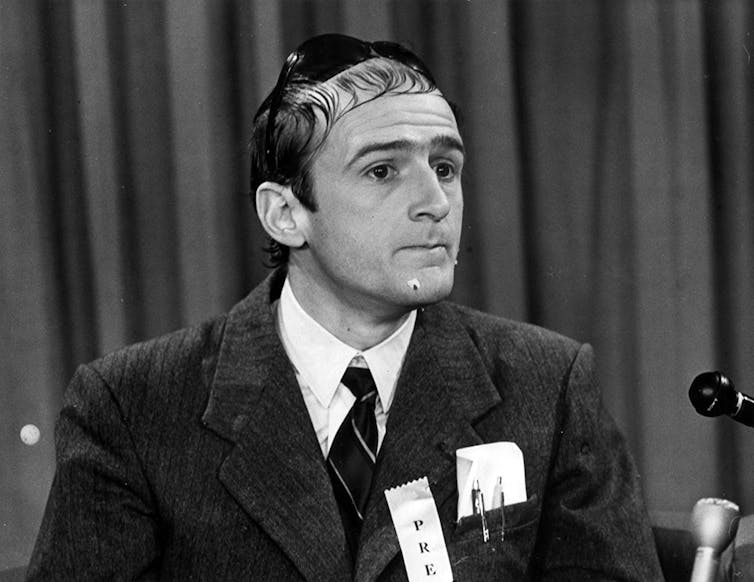
Garry McDonald in The Norman Gunston Show (1975). Seven Network/ABC

If this is so, what might be causing it?

The viral curse

The one real recent change in the covenant between comedians and their audience is the advent of social media, especially the ambition of going viral. We think that may be one reason why so much current comedy and satire tends to be safe, and obviously preaching to the converted.

The current king of viral satire is the American John Oliver; his Last Week Tonight is ostensibly an HBO TV show, but it has a vibrant second life chopped up in shareable YouTube chunks. Oliver rants about topical issues using a plethora of news clips and pop culture jokes, in a style popularised by The Daily Show.

It is impossible to deny both the humour and investigative depth of Oliver's segments, which have even achieved real social and legislative results. Indeed, his political force has led some to question whether he is a journalist first and a satirist second. Like an op-ed piece in a traditional hard news publication, Oliver's opinion on a topic is always clear and obvious from the get-go. Sadly, due to our increasingly polarized politics and the echo chamber effect of social media, this also means Oliver's satire is easy to ignore for those who don't agree with his arguments.

Australian television satire largely follows in the footsteps of Oliver and Last Week Tonight. Shows like Charlie Pickering's The Weekly, Shaun Micallef's Mad as Hell, and Tom Ballard's, now defunct, Tonightly all feature a (white, male) host "going-off" on the news of the day, usually via clips documenting the latest crime against logic committed by Andrew Bolt or the nitwits on Sunrise.

Tonightly versus Sunrise on 'a second stolen generation'.

Although they lack the writerly polish of Last Week Tonight, these Australian shows have similarly agreeable progressive politics and a vague goal of informing whilst entertaining. They also each have Facebook and YouTube pages full of digestible videos waiting to be shared, though it's unlikely anything here will move anyone's partisan needle.

Maybe this is an unreasonable expectation, as satire seldom changes minds no matter how conclusive those who already agree with it find the critique. But the tendency to confirmation bias seems particularly strong in this moment and mode. As Ben Neutze has written in his critique of The Weekly:

The editorials presented by their hosts are meant to set an agenda and become viral content — the kind that people who share the same opinion can point to on social media and say: 'That's what I mean! That's my argument!'

Is this the best Australian satire can hope for in the online age, to be the funnier rendition of an opinion someone already holds? Not necessarily. There is still some inventive and even unsettling satire being produced and shared online in this country.

Edgier fare

One example of edgier online material is The Honest Government Ads. Produced by Juice Media, a small Melbourne-based film company, these short, satirical videos co-opt the upbeat tone, corporate muzak, and smiling spokespersons of actual Australian government campaign videos, all whilst taking aim at the body politic's complacency on a wide range of social issues.

Parody and irony are classic tools of satire and their powers are amplified here by the way Honest Government Ads are disseminated through social media sites like Facebook. A lack of context means your unsuspecting, conservative uncle is free to stumble upon a posted video and start nodding in agreement to the idea of making it "mandatory to only have fun on January 26".

Whether or not anyone could really miss the irony in a video that joyfully refers to Australia Day as "Amnesia Day" is debatable. Still, there is plenty of research to suggest even blunt irony will not always get between the audience and its preconceptions. A great study from 2009 that surveyed liberal and conservative students who watched the satirical TV show The Colbert Report, found that:

there was no significant difference between the groups in thinking Colbert was funny, but conservatives were more likely to report that Colbert only pretends to be joking and genuinely meant what he said while liberals were more likely to report that Colbert used satire and was not serious when offering political statements.

Perhaps that is why Colbert took to fronting a "straight" tonight show?

Anyway, the federal government was certainly worried enough about the possibility of people misunderstanding the Honest Government ads to send Juice Media a "cease and desist" letter regarding its use of the Commonwealth Coat of Arms. Apparently the average Aussie can't be trusted to know that the real coat of arms doesn't feature an alien skull, or that "Australien" is not the usual spelling.

Honest Government Ads video, complete with mispelt, faux coat of arms.

The Honest Government Ads new coat of arms now has a proud motto "not the real logo" front and centre in a meta-video that digs into the "shit-c..nts" at Juice Media who have "tricked millions of hard working Australians into believing their government is honest".

This video is featured on Juice Media's Facebook page, where it has a garnered just over 400,000 views. This is nowhere near Last Week Tonight's regular seven-figure viewer numbers, but still a significant achievement for a small-scale operation with no platform other than the "click and share" of social media.

It's the sort of work that makes one cheerfully speculative about satire's possibilities in an age when Facebook is the main news source for millennials and the main "fake news" source for everyone else. Even if there are legitimate worries about the hazy border between satire and fake news, the prospect of independent artists like Juice Media continuing to lob clever, irony-grenades into our daily scroll is still enticing.

Nonetheless, this type of satirical comedy is still predominantly preaching to the converted (and the odd humourless bureaucrat or ministerial aid); it's just clever enough to do so in a way that tricks its enemies into participating in the sermon. If anything, the ironic humour of the Honest Government Ads probably serves to strengthen the online echo chamber, creating a divide between those who "get it" and those who don't. And since no-one really feels sorry for the government as a bureaucratic rule enforcer, there's a clever point being made here, but nothing really dangerous.

The truly challenging

Truly challenging satire discomforts even those who "get" it. For example, Get Krack!n's deadpan takedown of Sunrise et al. frequently straddles the border of bad taste in a way that makes its viewers complicit just for laughing.

Or consider any one of a number of sketches from ABC's Black Comedy, whose three seasons have been giving humorous voice to a genuinely under-represented and often oppressed group.

Our "favourite" – really the one that made us feel most vertiginously and unanswerably undermined as white Australians – is a skit where a sick Indigenous girl is granted a wish by the "Ultimate Dream Foundation" and simply asks for her people's land back.

Using sick kids to make a point is seriously un-PC, and it's especially risky in the wake of the Chaser's Make-A-Wish controversy, where they were driven to apologise. But the payoff for Black Comedy is equal parts hilarious and disconcerting.

The dark irony of the charity workers' bewildered response – "well we either give the Aboriginal people their land back … or we cure cancer" – is far more powerful than Tom Ballard calling a politician a dirty word, and trumps even the "gotcha" trickery of the Honest Governments Ads.

There is no exit for even the most progressive and well-meaning non-Indigenous viewer here; no pat on the back for "getting it". Whilst an Indigenous person already knows the scale of deprivation, the colonial viewer can either confront their guilt or bury it even deeper.

Sadly for such brilliant, searing satire, the video's roughly 5,000 views on YouTube suggest it hasn't gone anywhere near viral — more evidence that the internet can be stupid. Perhaps the skit's failure to neatly encapsulate a partisan talking point or offer any sort of redemptive action hampers its shareability. You can cut your progressive identity to shreds on the ironies in this skit, and maybe it's not cool to extend that risk to your social media friends.

After all, despite our grumbling about filter bubbles and personalised algorithms, research suggests that our own choices about what to share are as responsible for social media echo chambers as anything else.

We build the house of comedy we live in, and at the moment it is designed for tickling our confirmation bias and not much else. So the next time something uncomfortable manages to sneak past security, something that traps the laughter in your throat, for the love of comedy: share it.

John Horn with his wife and son in their Wake Forest University gear. (Courtesy John Horn)

My wife and I just went through the college admissions process with our eldest son. It was exhausting, exhilarating, disappointing, and ultimately satisfying.

We did not cheat. And yet it's no surprise at all that other parents did.

The most startling takeaway from the FBI's investigation into how rich parents cheated and bribed to get their children into elite schools is not the tawdry details of the scheme, which allegedly included rigging achievement tests and directing huge payments to sports coaches.

Instead, the real news is that we somehow haven't heard about these tactics before. The business (and it is a business) of college admissions almost encourages this kind of behavior.

In the aftermath of Tuesday's indictment — whose targets include actors Felicity Huffman and Lori Loughlin, along with other prominent figures — there will be countless judgments about the parents' actions, most of them appropriate. And the purported tactics are indeed extraordinary: fake students taking tests, photoshopping a non-athlete's head onto an athlete's body, bribes to coaches and test proctors, and much more.

But what might be lost in all of the chatter at school drop-offs is how the college admissions culture is itself to blame, as it helps turn otherwise rational people into, well, criminals — especially those with money and privilege. You can see it in what one mom, marketing executive Jane Buckingham, allegedly said to the government's confidential informant about her son: "I need you to get him into USC."

Our son is a freshman at Wake Forest University (which was also implicated in today's indictment). He worked hard in high school, got good grades, and tested well on the ACT. He applied to several schools. He was rejected by some, admitted by others.

That's the way it goes, and as I tell many parents: "The best school for your child is the one that wants your child." And for our son, the school he attends has turned out to be a great match.

Read more: USC, UCLA Athletic Officials Among 50 Charged In Alleged College Admissions Bribery Scheme

Not everybody sees it that way, and as soon as their son or daughter is out of diapers, they try to engineer a different outcome. As Gordon Caplan, a prominent attorney indicted today, allegedly said while discussing how he would cheat to get his daughter into college: "Keep in mind I am a lawyer. So I'm sort of rules-oriented."

"Sort of" indeed.

I know parents who, when their kids were just 2 years old, would obsess over applications to selective private preschools, convinced that there was only one place to finger-paint and shovel dirt to set their child up for academic excellence.

I know parents who hired tutors to try to get their kids into those same preschools.

I know parents who worry that their first grade classroom is not academically challenging enough, and could somehow thwart any chance their 7-year-old has for an Ivy League college.

I know parents who fail to question a high school curriculum that favors Advanced Placement classes (largely designed solely for AP tests, and its resulting boost on a college application) over studies into subjects whose personal and intellectual rewards could be more meaningful than an AP grade.

The parents aren't the only ones to blame. Thanks to rankings by magazines like U.S. News & World Report, high schools obsess over their college placement. College counselors will sometimes steer students away from the college they actually want to attend to a more prestigious campus for no obvious reason other than such rankings.

When parents start swimming in that world, they can start to believe in any means necessary. And that's how we reached today's indictment, which of course does the greatest disservice to the kids whom the parents were trying to "help."

quarta-feira, 13 de março de 2019

Most of my college friends were impressive procrastinators â€" they'd be doing their homework on their way to class, scribbling it all down before the professor would walk around to collect it. Many of them would spend all-nighters in the library writing up 40-page essays, finishing up and printing them out just moments before class the next morning.

I've always been quite the opposite â€" and largely because carrying around the burdening mental load of work stresses me out even more than filing my taxes every year. Lingering deadlines â€" in the coming days, weeks or even months ahead â€" clutter my headspace. It's almost like I always just need to clear the slate. It's for the same reason that I pay my credit card bills in full every month, even when it crushes me. And it's exactly why I simply have to read or clear every unread email each morning to clean up those inexplicably exasperating little red notifications.

As I've progressed through my career, little has changed â€" especially, when I began freelance writing full time, juggling multiple assignments for multiple editors each week. There's nothing more satisfying than literally crossing off a tangible to-do list. I'll work through the night on a Tuesday to finish a story due on Monday the following week, just because I'm in a groove and, well, why shouldn't I?

But science says that there's an easy answer to that. In fact, there are plenty of valid reasons not to pre-crastinate. While it's usually done with good intentions, it's setting a lot of women back in the workplace.

Pre-crastination is, in short, the opposite of procrastination. But pre-crastination, which refers to getting the job done well in advance of its deadline, isn't necessarily a better plan. But why do we do it?

"Is pre-crastination â€" exhibited by college students, bill payers, e-mailers, and shoppers â€" a symptom of our harried lives?" ask David A. Rosenbaum and Edward A. Wasserman in their piece, "Pre-Crastination: The Opposite of Procrastination," for the Scientific American. "It is possible... that pre-crastination amounts to grabbing low-hanging fruit. If grain is nearby or if a bucket is close at hand, then it may be best to get it while it's available. Another explanation is that completing tasks immediately may relieve working memory. By doing a task right away, you don't have to remember to do it later; it can be taxing to keep future tasks in mind. Requiring people to delay performance of a task often worsens their performance of it."

A simpler account, they suggest, is that task completion, in and of itself, is just plain rewarding.

One study on the economics of effort, "Pre-Crastination: Hastening Subgoal Completion at the Expense of Extra Physical Effort," suggests that many of us are willing to exert extra effort just to complete jobs faster. The study asked university students to pick up one of two buckets (one to the left of an alley and one to the right), and carry it to the alley's end. The researchers emphasized choosing the easier task and, in most of the trials, one of those buckets was closer to the end point. While the researchers expected the students to choose the bucket closer to the end point, which would mean that they didn't have to carry it as far, most students actually grabbed the closer bucket because they wanted to get it done faster. But, the fact of the matter is, it took just about the same amount of time, after all.

"We concluded that this seemingly irrational choice reflected a tendency to pre-crastinate, a term we introduce to refer to the hastening of subgoal completion, even at the expense of extra physical effort," the researchers report. "Other tasks also reveal this preference, which we ascribe to the desire to reduce working memory loads."

In other words, pre-crastinating can be taxing, too. While it helps to alleviate the mental load of work that needs to get done, it often means that we're working ourselves harder just to achieve the same results. I also think about how, if I make more time for myself by finishing my work early, I'll always fill that time with more work. In other words, I often find myself giving myself more work than I'd otherwise do, which can sometimes lead to burnout.

So if pre-crastinating can actually set us back since we're exerting extra effort for little or no obvious reward, how can we avoid this behavior (without falling into procrastination)? Here are three ways to stop pre-crastinating.

1. Make a prioritized to-do list

One way to help you stop pre-crastinating is by prioritizing the work you have on your plate. When you write a physical list of everything you have to do and by when you have to do it all, you can prioritize the most urgent (or time-consuming) tasks. This way, you won't feel like you have to get it all done at once, and you can rest assured that it's on your list to think about another day.

2. Set starting deadlines

Often, the idea of a deadline can induce stress, because we know that we have to get something finished by a certain date. But one way to ease the stress of feeling like we have to get started ASAP is by setting a start deadline that leaves enough time to complete the task by the finish deadline.

3. Take breaks for self-care

It's important to slow down and take a step back to take mental breaks. If you're always busy worrying about all the things you have to do, you'll spend a lot of your time and energy thinking about it rather than actually doing it.

Mental breaks to journal, meditate, practice breathwork techniques, listen to music or do other calming self-care activities can help you to maintain your sanity, which you need to be productive and perform well in all of your tasks. While doing these activities, you'll learn to stop living such a harried lifestyle and to be more mindful of the ways in which your work are affecting you mentally and physically.

AnnaMarie Houlis is a feminist, a freelance journalist and an adventure aficionado with an affinity for impulsive solo travel. She spends her days writing about women's empowerment from around the world. You can follow her work on her blog, HerReport.org, and follow her journeys on Instagram @her_report, Twitter @herreport and Facebook.

terça-feira, 12 de março de 2019

If you are one of the 350,000 followers who wait, trigger-finger poised, to "like" the latest one-liner delivered by the colorful and outspoken art critic Jerry Saltz, you're in luck.

The New York magazine critic and recent Pulitzer Prize winner announced today (via social media, naturally) that he is writing a new book called How to Be an Artist, based on an essay of the same name that he penned as a cover story for New York last fall. (He also posed as the magazine's cover star, adopting the guises of artists Frida Kahlo, Andy Warhol, and Salvador Dalí.)

The book will be published by Riverhead, an imprint of Penguin Random House, as part of a two-book deal with Saltz, according to Publishers Marketplace. It is due to hit shelves on March 3, 2020.

Saltz's original essay outlined 33 rules for being an artist (or at least, living more creatively) and featured pithy lines that fall somewhere between inspirational life coach and stern-aunt straight talk. Sample pearls of wisdom include "start with a pencil," "accept that you will likely be poor," and "art is a form of knowing yourself."

In an email to artnet News, Saltz insists that his advice should be taken "not as prescription but as constellations of ideas and observations."

Saltz worked as a long-haul truck driver and artist before becoming a full-time critic. (He wrote about his life as a failed artist in an award-winning essay for New York.) He has often spoken about his admiration of fellow critics who are "of the people" and unconcerned with the cloistered, hermetic world of academic art criticism, citing Sister Wendy Beckett, Bob Ross, and Mr. Rogers as major influences on his writing style. We can expect more of this "people's critic" approach in his forthcoming books.

"I wasn't trained in art so I know what it is to feel as if I don't 'know,'" Saltz told artnet News. "I know that I still don't know what 'a Matisse' means. But I might be able to record—like a demented Geiger counter—scores of possible thoughts one might have in front of a Matisse."

Follow artnet News on Facebook:Want to stay ahead of the art world? Subscribe to our newsletter to get the breaking news, eye-opening interviews, and incisive critical takes that drive the conversation forward.

segunda-feira, 11 de março de 2019

← Press Releases

London, UK, July 4th 2018 - essayextender.com has started promoting its essay writing services on social media platforms. The firm has said that it's confident that by promoting its essay writing services on social media platforms like Facebook, LinkedIn and twitter; it will be able to attract more new clients looking for essay writing services. The company has realized that more students can be found on social media and the best way to reach and engage them is by increasing their presence on social media platforms.

The good site has started promoting its services on social media, move that is expected to attract many customers. The company's dream has always been to become an ideal stop for many customers looking for essay writing services and the company is full confident that the new move to promote its services on social media will help them achieve this. The firm has also said that it has the most trusted team of experts in place that will help you through your journey of finding a high quality essay.

The firm which can be easily accessed through this helpful link fully understands that Time is a very important factor to consider when looking for an essay writing service. Essayextender.com works on all your orders in the most professional way and delivers them on time. This is an advantage on your side because you get to save a lot of time. The useful site has also introduced a money back guarantee that will apply to all orders placed in the firm's website. The company has also invited all customers looking for the most trusted essay writing services to work with them and get to work with professionals.

This firm is the best for all customers looking for essay writing services in the online market. For more information please visit http://www.essayextender.com/dont-wait-up-use-our-essay-inflator/

Contact information:Dwayne CottonEmail: [email protected]

domingo, 10 de março de 2019

Many professionals are afraid of building their own products because they have the wrong assumption that every form of marketing has big costs associated with it.

That's far from the truth, as there are countless methods of marketing a product or a fundraising campaign, without the necessity of a big budget.

The digital environment allows us to reach and communicate with your target audiences like never before. Social media networks, for example, can be leveraged to increase your fundraising campaign's awareness with no cost, while search engines can help you expose your work to hundreds and thousands of people, organically and for free.

In today's post, I'm sharing several marketing strategies that can be performed without financial costs. Nevertheless, when money is not involved, your time, attention, and energy are just some of the resources you'll have to "pay" instead on a consistent basis.

1. Write amazing guest posts

Content marketing is one of the most effective digital marketing strategies that can be performed without the need for a budget. Considering that you're a decent content writer, you can start contributing to various niche magazines and blogs through guest posting.

This involves writing a quality post that matches the guidelines and expectations of the blog you're targeting. The benefit is that you can include links to your fundraising campaign's landing page, product page, or to any of your articles, so many targeted individuals might follow your link and discover your initiative.

If words are not your forte, I'd suggest you outsource academic writers. They're not only more committed than regular freelancers, but they also master the English language better than most people. AustralianWritings Essays is just a recommended platform, though you can find plenty others online.

2. Offer valuable advice on niche forums

People that use forums are generally interested in three things: to solve problems, to satisfy needs, or to engage with a community of likeminded individuals.

As a product owner, you can reach your audience by engaging in the industry forums that are mostly visited by your prospects.

Some forums will give you the chance to create a forum signature. If that's the case, use the opportunity to place a link to your fundraising page.

Also, ensure that you're providing high-quality answers and that you're not being too intrusive with your marketing approach!

3. Leverage Quora to bring targeted free visitors

Quora acts exactly the same as forums, only that the mechanism is a bit different. In case you're not familiar with Quora, it is a questions & answers platform that connects the problems and needs of people with the solutions of other people.

Simply put, if you can provide useful answers to people's queries and if you do it consistently, you'll improve your organization's reputation and reach.

You're also planting "seeds" every time you post something. Therefore, if one year from now somebody seeks a question you've answered, they'll discover your product link and may be tempted to pay you a visit.

4. Use social media groups to connect with prospects

Social media marketing is a goldmine opportunity for both marketers and consumers. Social media groups hold a great potential that can be leveraged for free.

This marketing strategy is quite simple: find relevant groups with people who might be interested in your brand's offering and your product's value and start engaging.

Most people are already using at least one social network on a daily basis. To sell your dream and fundraising campaign well, you need to constantly place it in front of your target audience. If social channels offer you this chance for free, why not leverage it?

5. Create an email marketing strategy

Building an email list is the best way to decrease future marketing costs. Additionally, an email list allows you to connect with your prospects on a deeper level. It allows you to share personalized information and relevant solutions every time you want it, so skipping this strategy is never encouraged.

Developing an email list isn't hard at all. You'll need an email marketing strategy, an autoresponder, and the drive to offer a lot of exclusive value.

The more value you provide the more trust you'll get from your followers and fans. After you've "warmed them up", you can introduce your concept or product and expect a much higher conversion rate than ever before.

6. Craft a strategic email signature

Why not leverage email signatures to constantly display your organization's name? If you're not familiar with email signatures, here's how you can create a good one.

The strategy is simple: create your signature and engage with prospects and clients. Whenever people open your emails, they'll immediately see your signature. In time, your product page will benefit from additional traffic and sales.

7. Leave thoughtful comments on relevant blog posts

Instead of submitting blog posts yourself, you can visit other blog's content and leave insightful comments that may add up value. There are so many readers who are eager to see the opinions and comments of others, so they'll head straight to the comment section once they've finished reading.

This gives you the chance to display your company's value proposition, and obviously your product's characteristics. A simple link back to your product page won't hurt if you've made sure that your comment has changed the lives of others for the better.

8. Leverage the power of Reddit

Reddit is a great source of free traffic. However, before you plan an aggressive marketing approach, you should acknowledge the fact that Reddit users are extremely skeptical when it comes to anything that involves marketing and promotion. On Reddit, you can find unlimited subreddits, which are basically categories that you can target according to your marketing needs. For example, if you're marketing the concept of improving ocean fishes' lives, simply search for "Fishing" and you'll get news, discussions, and various subtopics.

It goes the same with every niche. Now, once you find the most relevant subreddits, places that your target audience frequently visits, you can start following the discussions and begin contributing whenever you have something to add.

As I've already mentioned, Reddit users hate cheap marketing, so before adding any promotional link make sure you add enough value to the table.

9. Create a YouTube channel

Let's not forget about YouTube, the second largest search engine after Google. There are many ways to promote your charity and products on YouTube. One of them would be to create a review and perhaps show your product in action.

Second, you can create educational videos that your community will be eager to consume. Third, you can comment on other relevant videos and link back to your YouTube channel or the product page/fundraising copy page.

10. Host a giveaway

A giveaway contest helps you spread your reach across social media channels, mostly because of its viral element. When you host a giveaway contest, you're giving away something for free. It could be an eBook, a case study, a product, or whatever you find suited for your audience's needs.

For people to participate, ask them to simply like and share your page. A more aggressive approach would be to demand likes, comments, shares, and a few tags. Depending on your niche and audience, ensure you give away something that'll spark curiosity and desire.

Conclusion

Marketing your product through a fundraising campaign, for free, is one of the best ways to begin your entrepreneurship journey without risking too much. If your organic methods gain traction, your organization's results shall also show significant improvements. When you finally dispose of a budget, it's quite advisable to start using it to speed up your product's growth.

sexta-feira, 8 de março de 2019

That's why I created "prehab."

If rehab is a way to recover from drug addiction, prehab is a program designed (by me, at least) to avert the whole mess in the first place. It's like pulling a Marty McFly with your future party self, pre-empting poor decisions way before you're drunk texting your ex and sleeping through Mondays. So I enrolled Sebastian as the test case.

Step one: not turning into my mother. I wasn't going to storm into Sebastian's room in riot gear or hold his eyelids open as I flashed before-and-after images of meth addicts. Tone mattered, and so did timing. I didn't want to submit him to the claustrophobia of a car-ride disquisition on the way to school ("Hugs not drugs, kid"). So, I started the way nearly all conversations do these days between fathers and sons: with both of us on the couch, slumped over our phones.

"You know I really, really care about you, right?"

"Um, yesss," Sebastian said, and already I was failing.

"It's just that your choice of LSD as a science topic scared me a little and I want to make sure that you're, you know, fine."

Oh God, oh God, Oh God.

"I'm fine," he said.

"Can you say what interests you about psychedelics?"

"What's interesting is that they're interesting."

O.K. It was a start, and it led to step two: a quick course in drug education. Mine, not his. Sebastian told me about "this scientist guy named Albert Hofmann" who in the 1930s studied rye or, more specifically, a certain fungus that grows on rye called ergot. As I worked to restrain all muscle movements in my face, Sebastia n read off his screen from his paper in progress:

"Hofmann synthesized LSD-25, or Lysergic Acid Diethylamide, as part of his studies and put it on a shelf for several years. Those years ended abruptly when he ingested a dose of the substance and immediately had one of the weirdest experiences of his life, saying that the devil had taken over his body." Hofmann, incidentally, died in 2008, at age 102. What a long, strange trip it was.